Showing posts with label Trade Unions. Show all posts

Tuesday, June 28, 2011

Saor Éire 2011 – A gathering for socialists and republicans: Video Essay

On May 7th of this year, éirígí held a day long conference in the Aisling Hotel in Dublin entitled "Saor Éire 2011 – A gathering for socialists and republicans".  

Below are a number of video's of addresses made to the conference by a variety of speakers on a range of subjects.


Thursday, June 9, 2011

éirígí Reply to Business Calls for JLC Abolition

The following letter from éirígí Sligeach activist Gerry Casey was published in this weeks Sligo Weekender (June 6).  Click on the image below to read it.

It was a response to an article in the previous weeks paper from a representative of the Sligo branch of the Irish Hotels Federation who called for the abolition of Joint Labour Committee's (JLC's).

The JLC's establish basic rates of pay and conditions of employment for low paid workers in a variety of employment sectors. 


Click here to read previous article on this issue.

Saturday, May 28, 2011

Restaurant Workers Demonstrate to Defend Conditions


Members of the Restaurant and Catering Workers Forum held a demonstration at the Annual Irish Restaurant Awards on Wednesday [May 25]. The Awards are hosted by the Restaurants Association of Ireland, which is behind an attack on the wages and conditions of workers in the industry by calling for the abolition of the Catering Employment Regulation Order


Friday, May 27, 2011

Resist the Latest Attacks on Workers Pay & Conditions


The Dublin governments enterprise minister Richard Bruton yesterday (May 26) issued a series of proposals designed to undermine the current system of Joint Labour Committees (JLC's), Employment Regulation Orders and Registered Employment Agreements (REA).  These are the structures which set basic rates of pay and conditions of employment across a variety of employment sectors.

Under Bruton's proposals, more than 200,000 workers could face further wage cuts and deterioration of their working conditions, particularly in the catering, hotels, security and hairdressing industries.


Minister for Enterprise Richard Bruton


Amongst his proposals are plans to cut overtime and end workers entitlement to Sunday premium payments that they currently are obliged to receive under the legally binding ERO's. He also plans to scrap half of the existing 13 joint labour committees and 'review' the remit of the remainder. Extremely worrying also for workers is the creation of a new procedure whereby agreement would no longer be necessary to change legally binding registered employment agreements.

Defending his plans, Bruton described them as “a fair and balanced set of proposals that would be in the interest of creating employment”.

Unsurprisingly, employers organisation IBEC welcomed these proposals but urged Bruton to go even further and abolish the JLC's completely. They too are pushing the line that the JLC's and ERO's are causing job losses and that cutting overtime, ending Sunday premium payments and abolishing these structures completely would actually create jobs.


According to Torlach Denihan of Retail Ireland (IBEC), the Retail JLC “is destroying jobs, is unnecessary because of the minimum wage and should be abolished.”

Not everyone agrees with IBEC or Minister Bruton's jobs claims. On Tuesday the government published the review it had commissioned on this whole area of JLC's. The authors of the report, Chairman of the Labour Court Kevin Duffy and UCD professor of economics Frank Walsh, made clear that abolition of this system will NOT create employment.

However, Brendan McGinty, IBEC's director of industrial relations, was more revealing in outlining the real motives in attempting to abolish the JLC's which has nothing to do with job creation.


IBEC's Brendan McGinty


Calling for the complete scrapping of the JLC system McGinty said: “These employers and workers (in the sectors covered by the JLC's) should be free to determine their own arrangements in the same way as the overwhelming majority of those in the private sector do.”


That is precisely why workers should be very worried about any attack on the JLC's. Let's be clear - the JLC's are no radical bodies acting on behalf of workers awarding them excessive rates of pay.


They are very basic structures designed to provide basic rates of pay and minimal conditions of employment for workers in extremely vulnerable sectors of employment. These are areas where trade union representation and collective bargaining are quite often non-existent.


When McGinty says he wants employers and workers to be free to sort their own arrangements like most in the private sector do, what he actually means is they want empoyers to be free to exploit their workers, to drive down wages and working conditions without any legal recall for their employees. They want their members to be free to intimidate, to bully, to hoodwink and to pit worker against worker in order to maximise their profits at workers expense.


One of IBEC's main arguments for abolition has been that employees rights are already covered by existing employment rights legislation. Once again however, this was dismissed by the authors of the government review who outlined quite clearly that primary legislation does not adequately cover matters currently dealt with by joint labour committees and registered employment agreements.

Even despite the presence of the JLC's and of the National Employment Rights Authority (NERA), an office of Minister Bruton's department whose mission statement claims that it “aims to secure compliance with employment rights legislation and to foster a culture of compliance in Ireland”, exploitation of workers is rife by McGinty's members within the private sector.


NERA's quarterly report for September 2010 (click here to read it) revealed that in the first nine months of last year, almost €600,000 in wages owed was recouped by workers following investigations by the authority of industry sectors governed by Employment Regulation Orders (EROs) or Registered Employment Agreements (REAs).


Last year also seen the highest ever numbers of cases being referred to the Labour Relations Commission (LRC). More than 15,000 complaints were made by individuals in 2010, an increase of more than 1,100 on the figures for 2009.


For anyone in any doubt the figures above are a compelling reason for workers to, at a minimum, maintain the protection and the rights afforded them through the JLC's and other legal mechanisms.


As éirígí have repeatedly pointed out, current legislation and its enforcement is inadequate. Employers have been forced to pay back money that they owed to their workers. However, the absence of fines in most instances or the miniscule fines when they are actually imposed coupled with the lack of prison sentences, means there is no effective deterrent for employers who break the law.


So rather than diminish and abolish JLC's and reduce the rights of workers, what is actually needed is that those already in existence need to be enhanced, enforced properly and punished severely when breached. A slap on the wrist and 'pay back what you owe' is not enough.  Employers who break these laws need to be going to jail for their crimes.


Condemning this latest attack on workers, éirígí Sligeach activist Gerry Casey described them as the the “thin end of the wedge”. He said that all trade unionists and workers must unite to resist what is “a serious attack on the living standards and working conditions of employees in already vulnerable sectors”.


Casey said: “These proposals to slash rates of pay and conditions have nothing to do with creating jobs as Bruton and the employers organisations would have us believe. This is part of a long term ideological strategy to drive down wages and diminish the rights of workers using the recession as their excuse. They are about creating even larger profits for employers and making it easier for them to exploit their employees.”


“They must not be allowed to succeed. If they do they will turn back the tide of all the hard won rights and entitlements that workers struggles have achieved over the past century, imperfect as they may be."


He added: “According to IBEC, Bruton should go further and abolish the JLC's altogether to bring the wage setting framework 'into the 21st century'. In reality, abolition of the JLC's, further restricting workers rights and scrapping premium payments would not be taking us into the 21st century as IBEC suggest, it would be taking us right back to the start of the 20th century.”


“All trade unionists and workers need to unite to defeat these proposals. Low paid workers have already suffered massive reductions in income in order to bail out the banks and pay off the private gambling debts of big business. There can be no compromise with these proposals.”


Thursday, January 27, 2011

Gallagher Job Losses will Lead to Fresh Wave of Emigration from Donegal

The socialist republican party éirígí has condemned the owners and management at Gallaghers Bakery in Ardara following the announcement of the loss of 124 jobs with the remaining 65 jobs also at risk. Party spokesperson for Tír Chonaill Micheál Cholm MacGiolla Easbuig said the job losses would devestate the economy locally and lead to a fresh wave of emigration from the county.

The job losses come as the parent company Aryzta, which also owns the Cuisine de France brand, have decided to shut down their frozen bread production line at the Ardara bakery and move it to Dublin.


MacGiolla Easbuig said: “These job cuts have been imposed, not to protect the company, but to maximise and increase the profits for the shareholders. It is just the latest in a long line of examples of the greed and callousness with which multi-national companies operate. They amass vast profits created by the labour of their employees, who are then cast aside as expendable commodities once the multi-national decides they can secure a few extra euro's profit for themselves somewhere else.”

He added: “The job losses are a devestating blow to Ardara and the entire south west Donegal region. This is a region that is already reeling as a result of mass unemployment and forced emigration, something we were led to believe was a thing of the past. Workers and their families who are already suffering hardship as a result of the savage cutbacks imposed by Fianna Fáil and the Green party in recent years, are now being thrown on the scrapheap with no opportunities for employment in the region. The end result will be ever lengthening dole queues and a fresh wave of emigration from the county.”

Gallagher's Bakery Ardara

Responding to the manner in which workers were informed of the job losses, MacGiolla Easbuig said: “The contempt with which the owners and management treated their workers is astonishing. Workers were informed by journalists outside the plant as to how their jobs were going to be dealt with. This is disgraceful behaviour and exposes the callousness of the company who care nothing about the impact their decisions will have on the very people who have created their wealth for them.”

He concluded: “ The decision by management not to take questions from the assembled workers and to only talk to them individually is an attempt at the age-old tactic of trying to divide and weaken the workers resolve. It is now essential that the workers, those who have lost their jobs and those whose jobs are under threat, unite and organise to protect their rights and that of their families and wider community. ”

Saturday, January 22, 2011

From Socialism Alone Can the Salvation of Ireland Come

Following months of discussion, éirígí recently adopted its position paper on socialism - From Socialism Alone Can the Salvation of Ireland Come. This is a critical development for the rebuilding of socialist republicanism in Ireland.

When éirígí was established as a campaigns group in April 2006 it did so as an avowedly socialist republican organisation, founded upon the principles of that champion of revolutionary socialism in Ireland, James Connolly.

The activists who ultimately founded éirígí had first asked themselves two questions: Was the objective of a socialist republic still relevant in today’s world? And if so, was there a need for a new political organisation to fight for the creation of that republic? With the answer to both these questions being a definitive yes, éirígí came into existence.

Four and a half years later, the party has reached another significant milestone with the publication of a major ideological policy paper. From Socialism Alone Can the Salvation of Ireland Come is not only an important development for éirígí as a political party; it is also an important for the development of socialist republicanism in Ireland.

From Socialism Alone Can the Salvation of Ireland Come does not simply reject capitalism in all of its forms; it also sets out éirígí’s vision of an alternative society based upon the public ownership of the means of production, distribution and exchange.

Over the course of the last century many Irish republicans have come to the conclusion that an Ireland which remained capitalist post a British withdrawal would not really be free at all. And éirígí is proud to follow in that tradition, to follow in the footsteps of organisations such as the Irish Socialist Republican Party and the Republican Congress and of individuals like Peadar O’Donnell, Liam Mellows, Constance Markiewicz, Frank Ryan and Mairéad Farrell.

However, From Socialism Alone Can the Salvation of Ireland Come is not just about éirígí taking its place in Ireland’s revolutionary tradition. It is also about changing the parameters of debate in republican Ireland and beyond. It is about building the theoretical foundations for a powerful movement in Ireland that will be uncompromisingly republican and socialist. A revolutionary republican movement that has class politics at the core of its analysis, a movement that will never again commit the mistakes of militarism, constitutionalism or the pernicious notion that labour ‘must wait’.

The process by which éirígí developed and adopted From Socialism Alone Can the Salvation of Ireland Come was itself an example of the type of participative democracy that éirígí wishes to see at the heart of a new socialist Ireland. This process saw an initial draft debated by the entire membership within their respective local Ciorcail (branches). Each individual member was afforded the right to suggest deletions, additions and amendments to the document.

Once the first round of discussion had been completed a second draft of the paper, based upon the feedback received from the membership, was drafted. This second draft was then circulated to the entire membership and again debated within the local Ciorcail. The feedback from this second round of discussions informed the drafting of the third and final draft of From Socialism Alone Can the Salvation of Ireland Come.

For the first time a dispersed voting procedure was used which saw members voting at meeting of their local ciorcal on whether to adopt or reject the paper. As with all major strategic and policy issues each member of the party had an equal vote. The result of this vote saw the paper being unanimously adopted.

While the process of developing and adopting From Socialism Alone Can the Salvation of Ireland Come took a number of months to complete, it was time well spent. éirígí’s unique decisions-making process, as contained within Bunreacht éirígí, places consensus building at the heart of a process of decision making.

Many Irish republican and socialist organisations are based upon outdated and anti-democratic ‘top-down’ models of decision-making. Such models are inherently unstable, leading to leadership cliques and internal divisions. Organisations which use delegate based organisational models, pressure cooker conferences and artificial deadlines to make decisions are invariably corrupted by leaderships who think they know better than their memberships.

Announcing the public launch of From Socialism Alone Can the Salvation of Ireland Come, cathaoirleach éirígí Brian Leeson said: “Ireland today is at a crossroads. We can continue down the path of capitalism and imperialism that has partitioned our country, exploited our population and impoverished our communities or we can strike out for a better future based upon national independence and socialism.

“From Socialism Alone Can the Salvation of Ireland Come correctly asserts that the only option that will work for the vast majority of the Irish people is that of independence and socialism.

“There can be no compromise between the exploiter and the exploited. It is a matter of their prosperity or ours – the slave owner and the slave cannot be prosperous together.

“éirígí is under no illusions as to the mammoth scale of the task that has been set out in this document. It is the same task that confronted the men and women of 1916 and it is the same task that confronted the thousands of republicans who fought the struggle over the last 40 years – it is about nothing less than the re-conquest of Ireland by the working people of Ireland.

“We need to start small while thinking big. We need to organise in our communities, in our workplaces, in our places of education, in our homes and on our streets. We need to make the argument with every single person who has no vested interest in the current rotten system that there is a better way and a better destination. There is a system that the working people of Ireland can have a stake in – that system is socialism and the time to start fighting for that system is now.”

To read From Socialism Alone Can the Salvation of Ireland Come click here

Friday, August 13, 2010

Roscommon Protest against Hospital Cutbacks


Tomorrow morning (Saturday August 14), a demonstration against proposed HSE (Health Service Executive) cutbacks at Roscommon County Hospital is to take place.  The protest march, organised by the Roscommon Health Action Committee (HAC) is to commence at the Hyde Centre in Roscommon town at 11am tomorrow morning and will proceed from there to the hospital itself, where a ‘Hands Around Our Hospital Protest’ will take place.

Like other hospitals throughout the region, Roscommon's has already suffered severe cutbacks and is bracing itself for more in the imminent future, including the possible closure of the hospital completely.

Roscommon County Hospital

A report commissioned earlier this year by the HSE West recommended the closure of the hospital.  Ironically, it transpires that the cost of having that report commissioned cost the HSE a massive €90,000, money which IMPACT Trade Union say could have kept 12 nurses or clerical staff employed from now until the end of the year.

Urging people throughout the West and Midlands to support Saturday's march, éirígí activist Gerry Casey said that there must be no compromise or backing down by the Unions in relation to the proposed cutbacks in the HSE West region.


Casey said:  "What is at stake here is of vital importance for future generations.  The planned cutbacks are not about reducing services or even closing hospitals due to necessity.  It is part of a planned strategy by the HSE, on behalf of the Fianna Fáil /Green party coalition to run down the public health service in order to pave the way for the privatisation of our hospitals and our health care system."

He added:  "The current health system we have is a medical form of apartheid where the wealthy get treated whenever they want, while those reliant on the public health service have to join ever lenghtening queues to receive essential treatment.  Such a system ensures that people suffer needlessly and die needlessly."  

"The release this week by the Irish Cancer Society (ICS) of figures showing the continued increase in the numbers waiting more than three months for a potentially life saving colonoscopy, is yet more evidence of the danger to life posed by the HSE and this administrations health policies.  People should be under no illusion.  Lives have been lost as a result of cutbacks and even more will be lost if they get to impose new cutbacks"


Casey continued:  "Mary Harney and her cronies in government peddle the lie that they have not the finance to properly fund our health service and that cutbacks are unavoidable.   But the bottom line is, as éirígí have repeatedly pointed out, that none of these cutbacks are in any way necessary.  Imposition of a wealth tax, the nationalisation of our natural resources and the proper distribution of the current finances at the governments disposal, would allow not just for a halt to any cutbacks, but also for a reversal of those already imposed and more importantly for proper new investment to be made to create an efficient public service available to all, based solely on medical need and not based on ability to pay." 


"Fianna Fáil and the Green Party have pumped tens of billions of euros into bailing out the banks and developers.  This is money that could have been used to fund our hospitals and invest in their future.  Given the choice of protecting the health and welfare of patients who rely on the public health care system or protecting the excessive living standards of the wealthy political and business elite, the coalition chose the latter."


"This is a fight that we cannot afford to lose.  There can be and must be no compromise or 'deals' on these cutbacks particularly from the leadership of the Trade Unions within the health service.  Reducing the cutbacks is not a solution - only the scrapping and reversal of cutbacks is acceptable.   Previous 'deals' have led us to this point.  As the INMO (Irish Nurses & Midwives Organisation) General secretary pointed out recently: 'The INMO voted against the Croke Park proposals primarily on the basis that they require 6,000 posts to be taken out of our health service in a haphazard, uncontrolled and unplanned manner with scant regard for the impact upon patients and their needs and requirements.  We are now seeing the real impact of this flawed approach.'"

Casey concluded:  "Support tomorrows (Saturday August 14) march and rally in Roscommon town and all similar protests against the proposed cutbacks.  Send the message to Leinster House - Fund our Hospitals, Not the Banks."

Sunday, August 8, 2010

Thousands Protest Against Hospital Cuts in Letterkenny

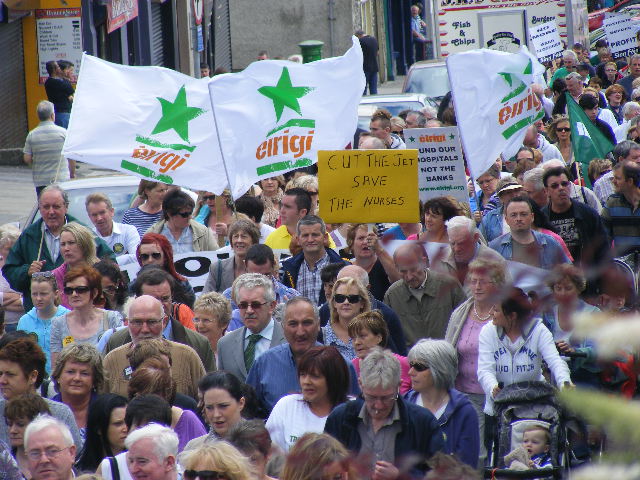
Thousands of people took to the streets of Letterkenny in Co Donegal yesterday (Saturday Aug 7) to show their anger at Dublin Government and HSE (Health Service Executive) plans to slash services at Letterkenny General Hospital and to impose other cuts throughout the health service.


Around 3000 people assembled at the station roundabout in the town at midday for the rally which was organised by the newly formed 'Save Donegal Health Services' campaign group.  Led by a piper, the large crowd marched up the Port Road towards the Main Street before turning up High Road and proceeding to the hospital itself where a number of speakers addressed the crowd.


Amongst those who delivered speeches to those assembled were spokespeople from the three main health service Trade Unions, IMPACT, SIPTU and the INMO (Irish Nurses & Midwives Organisation).  Speakers from the Voice of Older People Donegal (VOPD) and Donegal Action  for Cancer Care (DACC) also addressed the crowd.


The planned cuts for Letterkenny include a reduction in day services, the closure of an operating theatre, the removal of at least 13 beds from Orthopaedics and the Intensive Care Unit as well as the slashing of the numbers of hours being worked by almost 100 members of staff at the hospital.  They are also to close a pharmacy and shut the hospital's mortuary on a Saturday.  Similar cutbacks are planned at Sligo General Hospital and other hospitals throughout the region.


Smaller hospitals such as the Sheil Hospital in Ballyshannon and Lifford Community hospital, both in County Donegal, are threatened with imminent closure.  Now the HSE are saying that they may also close a major hospital somewhere in the west but they have refused to say which hospital they have their sights on.


Fianna Fáil and the Green party are also believed to planning even further cutbacks in the region of €600 million in the upcoming budget beyond these current plans to slash services.


Following the rally, the HSE issued a statement in which they claimed they would "protect front-line services" and that all services provided by HSE West would be provided in a "safe manner".


Sligo éirígí activist Gerry Casey, who was one of many éirígí activists from Counties Sligo and Donegal to take part in the Rally, dismissed the HSE's assertions saying that the planned cutbacks are "completely unnecessary" and will cause "unnecessary suffering and death".  He said the Dublin government are deliberately slashing services and stripping the health service bare to facilitate the privatisation of the public health service.


Speaking following the rally, Casey said:  "The savage cutbacks planned by the HSE and their political masters will decimate what remains of the public health service.  They are using the excuse of the recession, caused by their corruption and greed in the first place, to strip the public service bare and to  press ahead with the privatising of our public health service.  It is also being used to drive down workers wages and condition within the health service."


He said:  "Contrary to the lies and spin emanating from the political and business elite, all of these cutbacks are completely unnecessary.  While Brian Lenihan and Mary Harney say they cannot afford to properly fund our health service, they have no hesitation in pumping tens of billions of euros to bail out the banking sector and the wealthy business elite.  They have no hesitation in squandering millions of euros on flying around on the government jet or to invite the English Monarch here on a state visit.  The message is clear – the profits of the banks and the rich mean more to this administration than the health and lives of those who depend  on the public health care system."    


He added:  "Despite the recession, Ireland remains a wealthy country, where the rich have got even richer while workers and those on welfare have been made to bail out the banks and developers.  A wealth tax could and should be introduced to make the rich pay. Our valuable natural resources, which should never have been given away in the first place, must be nationalised and the hundreds of billions of euros worth of oil and gas utilised to create a first class health service for all."


Casey concluded:  "If the government are allowed get away with these proposed cuts, the reality is that people who cannot afford private health care will suffer unnecessarily and even die as a result.  We should not be surprised that this administration puts private profit before the health and well being of the people they claim to govern on behalf of but we have a duty and responsibility to not let them away with it.  If we fail to stop what can only be described as the wanton vandalism and destruction of our health service then future generations will suffer greatly and needlessly."


Thursday, August 5, 2010

Protest against Hospital Cuts - Letterkenny Sat Aug 7


As people will already be aware, the Health Service Executive (HSE), on behalf of their political masters in Leinster House, are preparing to cut staff numbers and slash services at hospitals throughout the country.  This includes both Letterkenny and Sligo General Hospitals here in the north west.  The future of other smaller units such as Lifford Community Hospital and the Sheil hospital in Ballyshannon are also under threat.


As this blog has regularly highlighted (click here for most recent article) the cutbacks already imposed on our hospitals and health service in general, have caused immense suffering and hardship to patients. According to the main nursing union, the INMO "the level of cuts, currently being imposed upon our public health service, are compromising patient care, lowering standards and greatly increasing the clinical risk to patients." 


Following their carrying out of a comprhensive review of the entire Health Service, the INMO said that they discovered the following:

  • Over 1,500 public beds are closed including beds in hospitals designated as Centres of Excellence resulting in longer waiting time for essential treatment

  • Very high levels of A&E overcrowding with over 300 people on trolleys, awaiting a bed, on nine days in July as compared to one in July 2009

  • Primary care services being curtailed, or suspended indefinitely, due to a shortage of nursing staff 

  • Intellectual disability services being curtailed, suspended or eliminated altogether, again due to the shortage of human or financial resources; and 

  • Frontline staff, in nursing, midwifery and other support grades, not being replaced resulting in frontline direct patient care services being compromised.


Letterkenny General Hospital


Amongst the latest cuts planned by the HSE for Letterkenny General Hospital are believed to be a plan to cut the working hours of 94 members of staff on fixed term contracts by eight hours each.  Such cutbacks will result in a devestating loss of income for these workers, particularly those who are only part-time.

What these cutbacks will mean for patients are yet more operating theatre and bed closures, more people left lying on trolleys, cancelled operations, longer waiting lists and unnecessary  and increased suffering and even deaths.  

 
Previous protest rally against threatened closure of Lifford Hospital


The INMO General Secretary, Liam Doran has claimed that the cuts being implemented are being "imposed in a manner which is unsafe" and are a result of the Croke Park Agreement between the Dublin government and ICTU on public pay reform.

Speaking on Tuesday he said that patients  "are entitled to quality assured services when they need them and public patients cannot be treated like second class citizens when compared to those who can afford private healthcare at this time”. 

He added:  “The INMO voted against the Croke Park proposals primarily on the basis that they require 6,000 posts to be taken out of our health service in a haphazard, uncontrolled and unplanned manner with scant regard for the impact upon patients and their needs and requirements.  We are now seeing the real impact of this flawed approach."

Sligo General Hospital

And while people are rightly horrified at these latest plans to cut services in our hospitals, even worse is set to follow.  In the upcoming budget, Health Minister Mary Harney is seeking a further cut of €600 million off the health budget.  Unless they are forced to halt these cutbacks and actually invest in creating an efficient first class health service for all, we will very soon be left no public health service at all.


This Saturday (August 7) a march and rally has been organised in Letterkenny, Co.Donegal to protest against the HSE's proposed cutbacks.  The march, which will commence from the Station roundabout in the town at 12 midday and proceed to the hospital, has been organised by the newly formed Save Donegal Health Services campaign group.  


The group is comprised of the three main health care trade unions, INMO, SIPTU and IMPACT.  Other groups involved include the Irish Kidney Association, Donegal Action Cancer Campaign, Friends of Letterkenny General Hospital, Co-operating for Cancer Care North West and the General Voice of Older People Donegal.

Health Cuts Protest Lifford

éirígí are urging people throughout the north west to attend Saturday's protest march in large numbers.  The HSE and their political masters in Leinster House need to realise and to see that as a community we are sick and tired of the savage cuts being imposed on us, at the same time as they bail out the banks to the tune of tens of billions of euro and as they feather their own nests and that of that of the wealthy business elite.

The people of the north west and the people of Ireland deserve a first class public health service properly funded, resourced and staffed.  It is our right, not some privilege to be dispensed at the discretion of overpaid and uncaring politicians who are intent on dismantling it and privatising it in order to make profits for their cronies within the business sector.  

Once again, the message is clear. Fund our hospitals, not the banks.


Monday, August 2, 2010

Workers Lead the Way in Venezuela

In the latest sign of the increasing radicalism of the Bolivarian Revolution, Venezuela’s National Union of Workers [UNETE] has published a series of policy proposals calling for more workers’ control of industry.


 Workers at a May Day rally in VenezuelaAmong the proposals are:
  • Full nationalisation of the banking and finance sectors
  • Nationalisation of foreign commerce related to essential foods
  • Readjustment of wages and prices to account for the cost of living and production
  • Creation of a ministry for workers’ control and social production, directed by workers’ councils
  • Introduction of a national maximum wage
  • Introduction of an industrial transformation law that will see idle companies and land transferred to workers’ or peasants’ councils
  • Demarcation of indigenous lands over the interests of transnational mining companies
UNETE is Venezuela’s primary union federation, having been formed in 2003 after the traditional federation CTV supported coup attempts against socialist president Hugo Chávez. Around 80 per cent of the country’s trade unions are affiliated to UNETE.


Early this month, president Chávez celebrated the first anniversary of the nationalisation of the Bank of Venezuela, which was bought over last year by the state and retained its entire workforce. It has also experienced tremendous growth since then.


Chávez said: “I don’t know if there has been any experience like it before in Venezuela of such growth. That means a lot of things. This throws out all of that information that is emitted from the laboratories of psychological warfare that global capitalism has set up in Venezuela… that manipulate and put fear in the minds of Venezuelans.”


The revolutionary government has also moved in recent months to challenge price speculation that has seen food costs skyrocket. Several supermarket chains have been nationalised and the government has opened its own restaurants.


At the opening of one such restaurant last week, commerce minister Richard Canan said: “The creation of these socialist arepa restaurants allows us to demonstrate to capitalist businesses that it is possible to have a venue where food can be sold at a fair price and not as a commodity, as it is under capitalist concepts.”


Chávex has spoken out against the bureaucracyThe UNETE federation’s national co-ordinators recognise the work that has been done by the Venezuelan government to improve the lives and conditions of the country’s workers and peasants, but argue that this work has been hampered by “bureaucratism, indolence, and corruption of functionaries who act like a fifth column... in the entire structure of a bourgeois state that refuses to die”.


The document produced by UNETE goes to the heart of a struggle that exists within Chávez’s United Socialist Party of Venezuela [PSUV] and within the Bolivarian Revolution itself. It is a struggle between a rank and file who are anxious to see the socialist transformation of Venezuela and a bureaucracy who seem determined to prevent that from happening.


Government leaders are not blind to the problems facing their project and measures have been introduced to remove power from such bureaucrats and place it in the hands of the workers. In May, Chávez swore in the new directors for the 15 industrial companies that make up Venezuelan Corporation of Guayana [CVG], the directors having been elected by the workers before being ratified by the president.


The CVG forms an important part of Plan Socialista Guayana. This plan came into being following the nationalisation of the giant steel plant SIDOR in April 2008. The workers there began to discuss what a socialist company would look like and how it could be run democratically. They set up their own Bolivarian Workers’ University, in which 1,300 of them registered, where weekly classes are given in important technical skills as well as political theory.


Guayana is the largest of Venezuela’s eight administrative regions and is an important industrial centre. Around 80,000 people work in steel, aluminium, iron ore and mining companies, which have all been nationalised. In conjunction with the Ministry of Labour, workers from the CVG came up with Plan Socialista Guayana last year.


Plan Socialista Guayana is a 10-year programme to turn the CVG companies into worker-managed, socialist operations. Under this plan, the companies will greatly reduce the amount of raw materials being exported and workers will focus on supplying local and national projects for the benefit of the people. The introduction of the plan was hindered by management and local government figures until Chávez himself stepped in. That directors for these worker-run companies have now been appointed shows that the Plan is now well under way.


A community council meeting in Santa Rosa, MeridaOther avenues have also opened in the attempt to combat the problems of bureaucracy. A prominent example is the community council. These councils were introduced with the intention of promoting the participatory democracy that is central to the Bolivarian Revolution, by having communities come together to address local problems and develop local projects. Over 30,000 community councils have been created all over Venezuela since their introduction in 2006.


This explosion has not been without problems, especially in terms of finance. The Venezuelan government passed an amendment to the community council law in May to clarify and strengthen the role of the councils in society. Councils are elected by assemblies that represent between 150 and 400 families in a particular area, and assemblies need 30 per cent attendance to form a quorum, ensuring a minimum level of community involvement in the affairs of the council.


In both urban and rural areas, numbers of community councils are coming together to form socialist communes. There are currently around 200 socialist communes being built at present, which are effectively creating a parallel, horizontal alternative to existing municipal authorities.


There are many people in Venezuela who are frustrated at the limited progress made over the past decade by their government, which continues to struggle against a hostile native bourgeoisie as well as a dangerous imperialist power to the north and its satellite state in Latin America, Colombia.


However, as long as the workers and peasants of Venezuela keep pushing towards the socialist transformation of society, the dream of the Bolivarian Revolution and of 21st century socialism will remain alive and well.

Monday, May 24, 2010

Thousands march to demand retention of Lifford Hospital


Thousands of people took to the streets of the border town of Lifford in County Donegal on Sunday (May 23) for a march and rally opposing HSE plans to shut Lifford Community Hospital. In sweltering heat, the large crowd assembled at the grounds of the threatened hospital before marching to the Diamond in the town.

Amongst those who addressed the Rally at the Diamond were representatives of the Save Lifford Hospital group, local clergy and political representatives as well as speakers from IMPACT, SIPTU and the INMO trade unions.


Speaking after the rally, éirígí Tír Chonaill spokesperson Micheál Cholm MacGiolla Easbuig who had taken part in the march with other éirígí activists, said that the demonstration sent a loud message to the HSE and their political masters in Leinster House, that the hospital is not for closing, and that they must fund our hospitals instead of the banks.


MacGiolla Easbuig said: “This Fianna Fáil led administration are systematically dismantling and destroying the public health service. Not only must their savage cutbacks be reversed, but our hospitals and the essential services they provide must be upgraded and provided with the necessary staff and resources so sadly lacking at present.”


He added: “There is a a general policy of slash and burn by Fianna Fáil and the Green party towards public health services in this country. Hospitals are being downgraded and shut down completely. Services are being reduced and moved further away from local communities. There are ward closures, bed removals, staff reductions and cuts in home help to highlight just a some of the outrageous and unjust cutbacks being imposed.”


“Make no mistake, the future of Lifford Community hospital is under serious threat. If we are to prevent its closure, then people power is the only way to do it. Todays march and rally was an excellent start but the momentum now needs to be maintained and intensified on the streets.”


MacGiolla Easbuig concluded: “The thousands of people who marched through Lifford today sent a loud and clear message to Fianna Fáil and the HSE. That message is to fund our hospitals, not the banks. As a community we have had enough of these savage health cuts and the closure or reduction of sevices in Lifford hospital will not be tolerated. We deserve a first class health service easily accessible and available to all based on a persons medical need, not their wealth.”


You can view more photos from Sunday's march & rally by clicking here


Saturday, May 22, 2010

éirígí welcome TUI & ASTI rejection of Croke Park Pay Deal


Sligo éirígí activist Gerry Casey has welcomed the rejection on Friday (May 21) by both the Teachers Union of Ireland (TUI) and the Association of Secondary Teachers of Ireland (ASTI) of the Croke park deal on pay and reform within the public sector. He also rejected comments by the Taoiseach Brian Cowen in Mayo today that rejecting this anti-worker deal was somehow not good for the country.

Casey said: “The fact that this deal was negotiated and agreed to in the first place by certain Trade Union leaders who claim to represent workers was appalling.”

“It offers public sector workers absolutely nothing. The TUI and the ASTI are to be commended for taking this stance and seeing through the propaganda being espoused by the Dublin government and the so-called Trade Union leadership who have attempted to coerce their members to endorse their sell-out.”


"Employers and the Dublin government are using the current recession as an excuse to drive down workers pay and conditions of employment. This deal is part of that process. It is designed to tie hands of public sector workers in their ability to take industrial action to defend their already rapidly diminishing pay and rights That the leadership of ICTU are colluding in this attack on workers is truly shameful and both they and the deal must now be vigorously resisted by all Trade Unionists and workers, both on the streets and in the workplace."


Reacting to comments by Taoiseach Brian Cowen on Mid west Radio during a visit to Mayo on Friday, Casey said: “It is ironic to see Cowen lecture workers to act 'for the good of the country' and to think of 'the bigger picture' considering the damage that he, first as Finance Minister and more recently as Taoiseach, has done to this country, and particularly to workers and the less well off.”

He added: “Those workers who voted to reject the Croke Park deal are the ones who clearly see the bigger picture and have acted in the national interest and in the interest of all workers. If Cowen wants people to act for the good of the country then he needs to take the first steps.”


He concluded: “ He needs to scrap NAMA, reverse the cuts in income and essential health and education services and nationalise our natural resources. In fact, considering the social and economic vandalism that he and his political and business cronies have caused, if he is serious about people doing what is good for the country, then he and his sidekicks should immediately retire from public life and ride off into permanent obscurity.”