Showing posts with label Apartheid. Show all posts

Monday, January 31, 2011

Solidarity with Bil'in – Remembering Jawaher Abu Rahmah


The small village of Bil'in has been a focal point and a symbol of resistance in recent years against the construction of Israel's illegal Apartheid Wall and against the occupation of Palestine in general.

Located just over 10 km from Ramallah in the West Bank, since 2005 this village of less than 2000 residents has been the scene of weekly peaceful protests against the 700km long wall which the International Court of Justice has ruled is in violation of International law.


The response of the Zionist regime to these protests, despite their non-violent nature, has been to unleash lethal force against those participating in them. Their violent repression using tear gas, rubber bullets and live ammunition has resulted in countless serious injuries and deaths.

The latest casualty was 36 year old Jawaher Abu Rahmah who was killed on new years day as the Israeli Occupation Forces attacked the weekly demonstration once again. She died after inhaling toxic tear-gas fired at demonstrators by Israeli troops becoming the first Palestinian casualty of the occupation in 2011.

Jawaher is not the first member of her family to be injured or die at the hands of the occupation troops at these weekly demonstrations. 

In July 2008 her brother Ashraf Abu Rahma was deliberately shot and wounded with a rubber bullet by an Israeli soldier standing right next to him.  This was despite  the fact that the military had cuffed and blindfolded Ashraf after detaining him for taking part in part in protests against the wall in the nearby village of Ni'lin.

In April 2009 another brother Bassem Abu Rahmah was shot dead by an Israeli soldier who hit him in the chest with a high velocity tear gas canister.

Less than 3 months earlier in January 2009 their cousin Khamis Fathi Abu Rahmah was shot in the head with a similar high velocity tear gas canister also while attending the weekly protest. He was hit as he held his hands above his head to show he was unarmed. Despite being seriously wounded and remaining in a coma for 12 days, Khamis was lucky to survive though his injuries still cause him to suffer to this day.

Local protest organisers and leaders have also being singled out by the Israeli authorities for arrest and imprisonment in an attempt to quash the protests and intimidate those taking part.

On the night of December 12 2009 Abdallah Abu Rahmah, the co-ordinator of the Bil'in Popular Committee Against the Wall and Settlements, was kidnapped by Israeli forces who raided his home at 2am in the morning. He was taken blindfolded from his home and remanded in Israeli custody. After an eight month long trial before a military court and despite the absence of any evidence against him, Abdallah was found guilty of “incitement” and “illegal protest” and sentenced to twelve months in jail.


 According to Amnesty International Abdallah is a prisoner of conscience, “jailed solely for the peaceful exercise of his right to freedom of expression and assembly.”

He was due for release on November 18 last year but was kept imprisoned as Israeli authorities sought to have his sentence extended. Earlier this month, an Israeli Military Court of Appeals at Ofer increased his sentence from twelve to sixteen months.

Abdallah's real 'crime', and that of the population of Bil'in, has been that they have refused to allow themselves be intimidated into submission. They have stubbornly resisted everything the state of Israel has throw at them and have fought tooth and nail in defence of their rights, against the construction of the wall, against the theft of their land, against the illegal settlements and against the occupation of Palestine itself. 


Tomorrow Tuesday February 1st demonstrations organised by Queens University Belfast (QUB) Palestinian Society and the Ireland Palestine Solidarity Campaign (IPSC) will take place in Belfast and Dublin. They are being held to honour the memory of Jawaher exactly one month on from her killing and to express solidarity with the people of Bil'in in their ongoing struggle against the might of Israeli occupation and repression.

The Belfast demo commences tomorrow at 12 noon at Queens University Student Union with the Dublin event commencing an hour later at 1pm outside the Israeli Embassy in Ballsbridge, Dublin 4.

Click here for more information on the protests


Click here and here for more information on Bil'in and the campaign against Israel's Apartheid wall


Monday, August 23, 2010

Protest against Apartheid Israel at Bray World Cup Qualifier

"Although no two countries or struggles are identical there can be no doubt that the success of the anti-apartheid movement and the BDS (Boycott Divestment & Sanctions) campaign that helped bring down apartheid, can be emulated with regard to apartheid Israel and the struggle of the Palestinian people.  The BDS campaign against the colonial, racist zionist state of Israel - guilty in fact of far worse crimes than apartheid South Africa - must be advanced and sustained with all the energy and unity we can muster." - Ronnie Kasrils, former South African MP and National Executive member of the African National Congress (ANC)


This Wednesday (August 25), the Irish Women's soccer team are set to play the first leg of  a  World Cup qualifying tie against Israel at the Carlisle Grounds in Bray, the home of League of Ireland side Bray Wanderers.  


This is the second Israeli side to play in Ireland in recent weeks.  Just last month Shamrock Rovers played host to Israeli side Bnei Yehuda Tel Aviv FC at Tallaght Stadium in a Europa League Qualifier.  On that occasion a protest to highlight the continued occuption of Palestine and to support the campaign of Boycott, Divestment and Sanctions against Israel, organised by the Ireland Palestine Solidarity Campaign (IPSC) and supported by éirígí, the Palestinian Rights Institute (PRI) and the Irish Anti War Movement (IAWM), was held outside the ground.


Once again, the IPSC have organised a demonstration, which will take place in two parts at two diferent locations in Bray.  The first stage of the protest takes place at the Bray Royal Hotel from 5.30pm as the Israeli Embassy are hosting a pre-match meal and reception there.  Following that, the protest will move on and continue outside the Carlisle Grounds from 7pm, with the game kicking off at 7.30pm


As on the previous occasion at the Shamrock Rovers game, the theme of this protest" will also be "Love Football - Hate Apartheid".  Banners bearing that slogan as well as 'Unity Against Occupation' and  'Boycott Israeli Apartheid' will be on show at the protests alongside Palestinian national flags.


According to the IPSC, the protest will call for a sporting boycott of Israel due to the racist and apartheid nature of the Israeli state. This is in support of the Palestinian Campaign for the Academic and Cultural Boycott of Israel (PACBI) who have confirmed this match falls under their Boycott, Divestment and Sanctions (BDS) guidelines.


Announcing the protest, IPSC National Chairperson Freda Hughes said: “Israel is a racist apartheid state with a human rights record worse than that of Apartheid South Africa. It continues to defy United Nations Security Council Resolutions and breaches International law on a daily basis. It is long past time that Israel was shown that there is a heavy price to pay for its human rights abuses, war crimes and continued denial of freedom to the Palestinian people.”


Ms Hughes added: "While some may suggest that sports and politics shouldn't mix, we believe there is no place in sport for racism or teams who act as ambassadors for racist or apartheid states.”


Ms Hughes continued: “Attempts by the Palestinian national soccer team to participate in International competitions are consistently hampered by Israel. Travel restrictions including refusing players exit visas as well as a complete ban on travel between the West Bank and Gaza makes training virtually impossible and has led to cancelled internationals. In 2006, Israel bombed their stadium in Gaza and three footballers were murdered during their month long attack on the strip last year.”


Ms Hughes concluded: “The IPSC are urging people to join the protests, to take a stand against Israeli apartheid and to show their solidarity with the people of Palestine. We are also urging Irish fans not to travel to Israel for the second leg of this tie. Similar to the International boycott of the Apartheid South African regime, Israel must be boycotted completely, including all sporting events such as this upcoming game. The Boycott helped end South African apartheid. It can be used again to help end Israeli apartheid and secure freedom for Palestine.”


Sligo éirígí activist Gerry Casey said that while Israeli apartheid and the denial of freedom for Palestine continued, a complete ban on participation by Israeli individuals and teams in sporting events similar to that which was imposed on apartheid era South Africa must be imposed.


Expressing support for the protest, Casey said:  "Human rights abuses, the illegal siege of Gaza and the occupation and colonisation of Palestinian land continues unabated.  Israel has seized further Palestinian lands through the building of their illegal wall.  The West Bank has half a million Israeli settlers living in illegal settlements, joined together by a network of special "Israeli only" apartheid roads, access to which is denied to Palestinians.  There are more than 600 military checkpoints across the West Bank, through which Palestinians need identity cards to get from one village to another."

 He added:  "While Israeli apartheid and the occupation of Palestine continues, then it is essential that the boycott of Israel be not just maintained, but expanded and intensified.  As well as economic and diplomatic  sanctions, Israel and Israeli teams and individuals, must also be completely blacklisted and banned from participation in all international sporting events just as apartheid era South African sports teams and individuals were banned."


Casey concluded:  "Wednesday's demonstration is a chance for people to once again stand with the Palestinian people and against the racist apartheid Israeli regime.  While the Dublin government shamefully refuse to take any action against Israel despite their war crimes and their kidnapping and brutalisation of Irish citizens, the message needs to be sent to Israel that those who represent that apartheid state are not welcome in our country."

For more information on the protest and the activities of the IPSC click here

Saturday, July 31, 2010

Petition: Thousands demand that Dunnes stop stocking Israeli goods


Click here to view original article courtesy of Ireland Palestine Solidarity Campaign (IPSC)


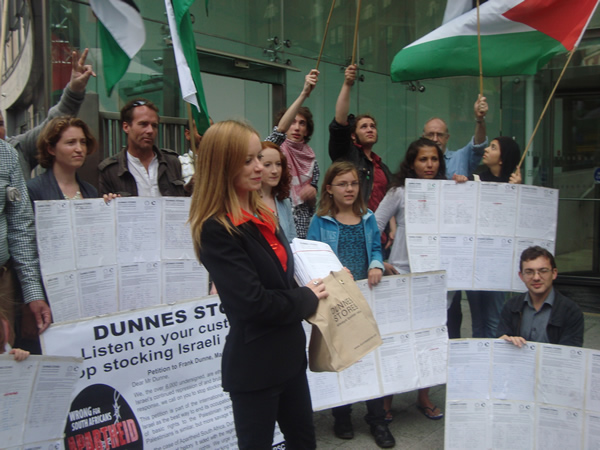
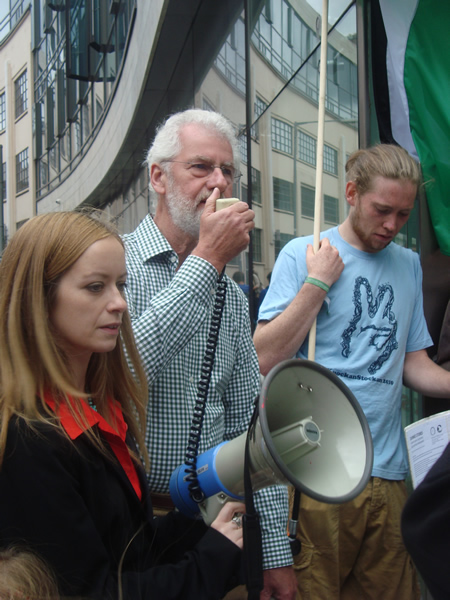
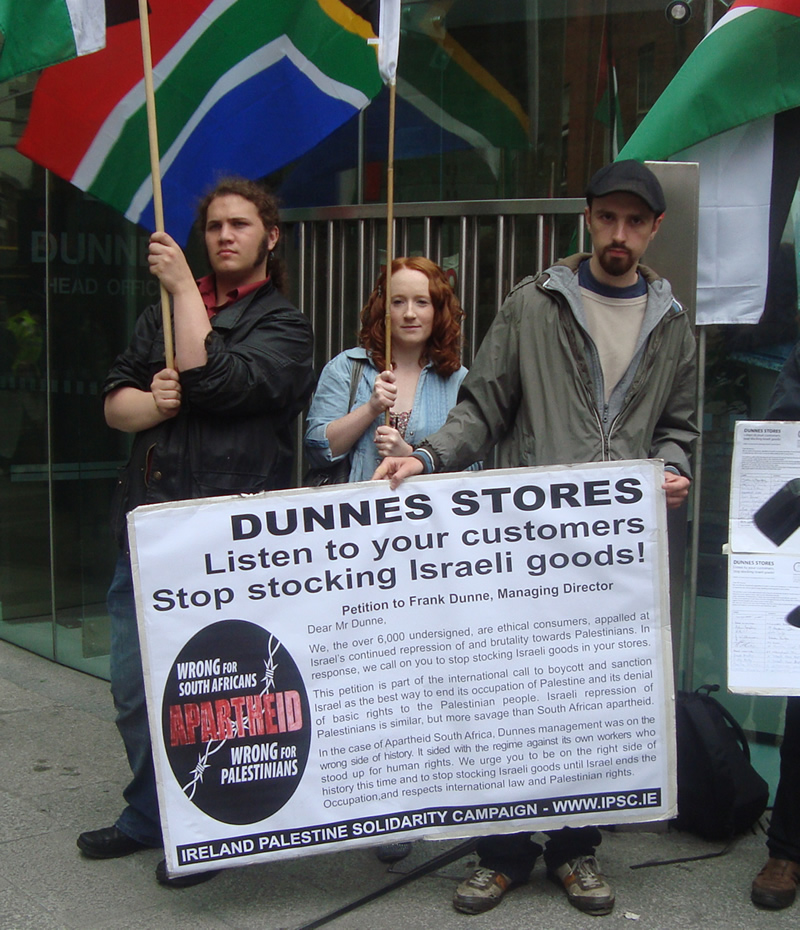
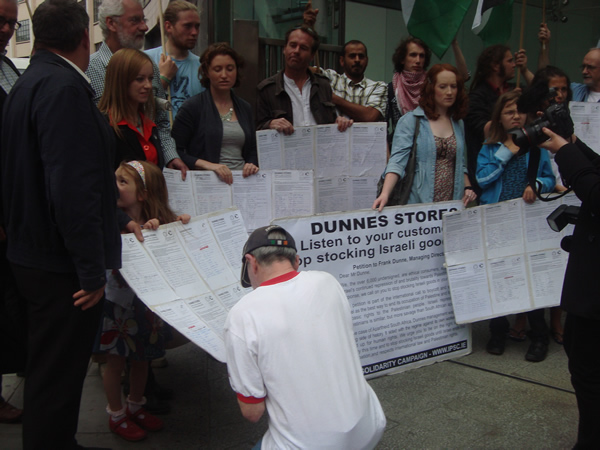
On Thursday last (July 29) the Ireland Palestine Solidarity Campaign (IPSC) delivered a petition to Dunnes Stores signed by over 6,000 shoppers across Ireland. The petition demands that Dunnes Stores stop stocking Israeli products, until Israel respects Palestinian rights and international law. Present at the handing-in were Brendan Archbold, the trade union official at the centre of the 1980s Dunnes strike when workers refused to handle South African goods, Freda Hughes IPSC National Chairperson, Aengus O'Snodaigh TD of Sinn Fein along with supporters of the campaign and members of both the Palestinian and South African communities in Ireland.


The petition has been signed by over 6,000 shoppers in a two-week blitz that has seen Palestine solidarity activists enlist the support of Dunnes’ customers across the country. Signatures have flooded in from Dublin, Belfast, Cork, Derry, Limerick, Galway, Kilkenny, Newry, Wexford, Waterford, Bantry, Gorey, Enniscorthy, and Sligo. In many locations around the country, solidarity activists presented their local Dunnes' managers with copies of the petitions they have collected.

This campaign comes a quarter-century after Dunnes was at the centre of a bitter two-year campaign of boycott and pickets, when it sacked a group of workers who refused to handle South African goods.

Freda Hughes IPSC Chairperson holding 6,000 signatures calling on Dunnes to stop stocking Israeli produce

"Dunnes was on the wrong side of history, siding with the South African apartheid regime against its own workers,"  Freda Hughes, IPSC Chairperson, said. "This is a chance for it to put itself on the right side of history. Israel's treatment of Palestinians amounts to nothing short of Apartheid. We must not ignore the lessons of South Africa and how apartheid was ended there – essentially it jumped before it was pushed. The boycott campaign can, and should, be used to isolate Israel both figuratively and literally until such a time as it complies fully with international law and ends its Apartheid regime in Palestine. We are not asking consumers to boycott Dunnes Stores. We are asking Dunnes Stores, and consumers islandwide, to boycott Israeli goods and services. This campaign is not designed to negatively affect Irish jobs."

IPSC activists collect signatures in Sligo (July 10)

Ms. Hughes
continued," We are delighted to see representatives from both the Palestinian and South African communities here today to show their solidarity and call for progressive steps to be taken in ending Israeli Aparthied and its abuse of human rights in the region. We are asking Dunnes to show its support for human rights and justice by refusing to stock Israeli goods just as the US chain-store Olympia Food Co-op in Washington State did last week."

Brendan Archbold
said, "The parallels between the old Apartheid regime of South Africa and the state of Israel are quite striking. Just as South African forces shot and killed their own people in Sharpeville and Uitenhage, so too do the Israeli military adopt a shoot-to-kill policy whether it is in relation to the Palestinian people themselves or those peaceful supporters of the Palestinians aboard the international flotilla recently attacked by Israel."


Brendan Archbold calls for Dunnes to boycott Israeli produce


Aengus O'Snodaigh spoke of his support for this campaign and said,"Israel has a long history of human rights abuses against the people of Palestine, and it believes it is beyond reproach for its apartheid policies. Israel needs to understand there are political and economic consequences for its crimes, and a consumer and retailer boycott of Israeli goods is an important aspect of holding Israel to account. I support this petition, but also call on the Irish and other European governments to suspend Israel's preferential trading status with the EU under the Euro-Med Agreement."

The petition campaign is part of a coordinated international effort for Boycott, Divestment and Sanctions (BDS) against Israel, which has seen actions take place in dozens of countries, including Israel and South Africa. Many South African organisations, and figures including Archbishop Desmond Tutu, have endorsed the BDS campaign.


Members of the Palestinian and South African communities attended the hand-in today 
Members of the Palestinian and South African communities attended the hand-in today

Passer by stops to sign the petition before it is handed in

For more information on the Camapign of Boycott Divestment & Sanctions (BDS) against Israel and on the activities of the IPSC please click here

Wednesday, July 28, 2010

No Private Hospitals – Fund our Public Hospitals: Health Crisis is "Deliberately Manufactured"

The most recent General Purposes meeting of Sligo Borough Council on July 19 heard proposals to build yet another private hospital in Sligo. Planning permission has been sought to develop the hospital on a site just off the N4 at the Summerhill Roundabout on the approach to the town centre.

This is the third such proposal in recent times. Last year it was announced that plans are underway to build a  €50 million private hospital right next to the existing Sligo General Hospital, while plans are also afoot to develop another such hospital at Carraroe.


Site of proposed new Private Hospital

All of this comes at a time when services at Sligo General Hospital are being slashed with further savage cutbacks already on their way.  Last year seen a dramatic reduction in services, including the removal of vital Cancer services to Galway, the downgrading of the Stroke Unit, the shutdown of wards and the closure of 78 beds.

The figures for the number of people left waiting on trolleys in Sligo General Hospital betweeen January and May of this year stood at a staggering 876.  Compared to the same period in 2007, the figure has more than doubled, up a massive increase of 419 people from 357.
As previously reported here, the Regional Director of Operations for HSE West John Hennessy confirmed in recent weeks that this year the Hospital was facing a budget deficit of €12 million and would mean new cutbacks which he admitted would impact on essential frontline services and would include yet more bed closures.  Amongst the measures he indicated were on the way were a ban on purchasing  equipment for the remainder of 2010 and the introduction of 5-day wards.


In the latest development at the hospital, staff were informed on Tuesday (July 27) that another eleven nursing positions were to go, a move that the INMO (Irish Nurses & Midwives Organisation) have said will have a "devestating impact" on essential frontline services.  According to the INMO spokesperson, the proposed cuts would decimate services at the hospital.


Impact trade union have said that among the other measures to be implemented by the HSE will be a further 60 bed closures as well a significant reduction in drug stock levels.  The HSE are also planning to alter the fixed term contracts of 25 employees.  According to IMPACT, in some instances this will result in workers having their weekly hours reduced from 35 hours to as little as eight hours per week

Reacting to the HSE's plans, IMPACT's Richy Carrothers has said that among the many areas affected will be essential radiology and oncology services.   In relation to the cuts in workers hours he said that "a reduction in the number of working hours, on the scale proposed, would devastate the lives of these workers."

He added:  “Reducing working time to just eight hours per week would mean that these workers, who are engaged in delivering vital services in the North West, could not earn a living wage, and would have to join the other reported 3000 public servants whose incomes are so low that they would have to claim family income support (FIS) from the state.”


Further north at Letterkenny General Hospital, the news appears to be even worse.  It is believed that up to 120 jobs are to go as well as the closure of the hospitals orthapaedic ward and it's medical rehabilitation unit.  Day services are also set to be reduced and all elective surgery is to be cancelled for the remainder of this year.


Responding to the latest proposed cutbacks and HSE nationwide figures which reveal that around 2000 nursing and midwifery posts have been lost since the introduction of the moratorium on recruiting nurses and midwives, the INMO described the current situation as "unsafe and unworkable".  The end result of this ban on recruitment is "longer waiting times for public patients for services, overcrowded hospitals with less inpatient beds, overworked staff and increased risks to both patients and staff" according to the INMO. 

At Belmullet District Hospital in County Mayo, the recruitment ban has resulted in ten of the hospitals forty beds lying idle as they have not the staff to cater for them.

Now the Dublin government, and Mary Harney in particular, are flagging up even more savage cuts in health care in the upcoming budget.  According to Harney the budget cuts in Health will be "substantial" and have "serious consequences for the health service".  This weeks Sunday Tribune reported that those cuts are likely to be as high as €700 million.


Once again, not only will patients suffer  and indeed die from the reduction in quantity and quality of service, but Harney has also revealed that the HSE would be focusing on changes in work practices and conditions within in the health service.  If the government get their way, it is front line staff, already  dangerously overworked and overstretched due to previous cutbacks resulting in increased workloads, who will have their already inadequate and unacceptable working conditions worsen.

And we know our health service is in deep crisis, but it is a deliberately manufactured crisis, one created by deliberate political decisions taken by successive Fianna Fáil led administrations.  What we have witnessed in recent years, and this blog has repeatedly reported on, has been the systematic stripping down and removal of services from Sligo General Hospital and other hospitals around the country.


This has not been accidental or forced upon the 26 county government by forces beyond their control.  Make no mistake about it.  This is ideology driven, pure and simple.  It is part of a deliberate strategy of running down the public health care system and increasingly privatising all aspects of health care, including our hospitals.

Fianna Fáil and the Greens are using the current economic crisis, brought about by a combination of greed and corruption by the wealthy political and business elite as a smokescreen for implementing these cuts and their real agenda, which is about privatising the public healthcare system.
 
Despite the Dublin government's claims, there is no excuse for cutting funding and services for hospitals. The money to properly fund our health service is there, only they believe spending tens of billions on bank bailouts and up to €10 million on bringing the English Monarch here, are more important than spending on people's health - well on working people's health anyway.

At the time of last years budget, Finance Minister Brian Lenihan attempting to justify his savage cutbacks said that there was "no pot of gold that can be raided from the wealthy that can solve our difficulties”. What he said then was untrue and remains so today.  The business elite in this country, who amassed billions of euros on the backs of workers throughout the so-called 'Celtic Tiger', remain wealthy individuals.  Indeed, despite the economic recession, the richest people in this country have got even richer.

There are also hundreds of billions of euro worth of oil and gas lying under the seabed off the Irish coast, the rights to these resources shamefully given away to multi-national corporations such as Shell, by previous Fianna Fáil-led administrations.  Those natural resources could and should be nationalised at the stroke of a pen.

Yet Lenihan and his cronies in the Fianna Fáil/Green Party coalition have taken deliberate political decisions not to nationalise these natural resources and not to make the rich pay.  Instead they are content to reduce the incomes of low paid workers and welfare recipients and slash essential health and education services.


So is there a solution?  Of course there is - but that solution is not in private hospitals. They have no place in the provision of health care. Private companies mean a hospitals priority is creating profit for shareholders, rather than patient care.

Private hospitals and private health care are also clearly not in the interests of working people, both those that use and need our health service and those that work within it.  Ironically the site of this new proposed private hospital is located adjacent to St Joseph's private hospital, the owners of which, the Mount Carmel Medical Group, in the past week have claimed an inability to pay redundancy in the region of €400,000 as recommended by the Labour Court to their former workers.

St Josephs Hospital


What we currently have in this state is a form of medical apartheid.  Those who can afford to pay, get their treatment when they seek it.  Those who cannot afford to pay are forced to endure lengthy waiting times for treatment that they may need right away.  The increased numbers of people waiting more than three months for a colonoscopy  (see here for previous story on Colonoscopy waiting lists) is just one example of how an essential procedure that could save a persons life is denied for lengthy periods to those who cannot afford to go private.  The end result of these delays for many people is quite often completely unnecessary suffering and death.

This two-tier apartheid system is completely unacceptable and needs to be dismantled immediately.  Health care is a basic human right - not a privilege - that must be free, easily accessable by all and must be completely under public control. Patients must be treated based on their medical need, not their ability to pay as things currently stand.


Tuesday, July 27, 2010

Donegal Hears Plans for New Aid Flotilla to Gaza

A Public Meeting held on Saturday last (July 24) in Donegal Town's Central Hotel heard in-depth eye witness accounts of the Israeli attack on the Gaza Aid Flotilla on May 31. 


Fiachra O'Luain from Inishowen in County Donegal and Cork native Fintan Lane, who were on board the Challenger 1, recounted in detail their experiences when Israeli commando's stormed their boat.  They spoke at length of witnessing the attack on the Mavi Marmara which resulted in the murder of nine of their colleagues on the Flotilla and outlined how they themselves and their colleagues were assaulted and brutalised by their Israeli captors on the boat and in Israel while in captivity.

Fiachra O'Luain Addresses Public Meeting-Donegal Town July 24 2010 from éirígí Sligeach on Vimeo.


Fintan, who was speaking on behalf of the Free Gaza Movement (FGM) which organised the Flotilla, also outlined the organisations plans for another Aid Flotilla during the Autumn.  He said that pressure must not just be maintained, but intensified, in order to support the people of Gaza and to bring the inhumane and illegal siege of the area to an end.


Following the accounts given by Fiachra and Fintan, a lively question and answer session took place, particularly relating to how people in Donegal and other parts of Ireland could help the Palestinian people in their ongoing struggle for justice and freedom.  Amongst the topics discussed was the ongoing campaign of Boycott,  Divestment & Sanctions (BDS) against Israel as well as the next Gaza Aid Flotilla and how individuals could assist in terms of finance and raising the issue in the media. 


The North West Forum's Jim McLaughlin, who chaired the meeting, said that another public meeting was planned for Donegal town at the start of September.  For more information check out www.ipsc.ie or phone 087 9730539

Friday, July 23, 2010

Gaza Aid Flotilla Survivors to address Donegal PublicMeeting


Two Irishmen, Dr Fintan Lane and Fiachra O'Luain were among the many pro-Palestinian activists kidnapped by the Israeli military during their murderous assault on the Gaza aid Flotilla on May 31. 

Nine people were murdered and many more injured by Israeli forces when they stormed the Mavi Marmara ship and other boats on the freedom Flotilla in International waters, hijacked the boats and kidnapped the crew and activists who survived the attack. Many of those who were kidnapped were brutalised by their Israeli captors.


Both men, who were on board the Challenger 1, will be in Donegal Town this Saturday (July 24) to address a public meeting and relate their experience during the raid, their kidnapping and their subsequent ill-treatment at the hands of their Israeli captors.
The meeting will also have a discussion on the continuing illegal siege of Gaza, while Dr Lane, a member of the Free Gaza Movement and the IPSC (Ireland Palestine Solidarity Campaign) will outline plans for the next flotilla that is to attempt to deliver much needed supplies to the besieged population of Gaza.

                                                                                       Fintan Lane             Fiachra O'Luain
Speaking immediately after their eventual release from Israeli custody at the beginning of June Fintan revealed some of the abuse and ill treatment they and other activists endured. He revealed how Fiachra was beaten up at the airport and had to be brought to hospital for tests.


He continued: “Ken O’Keefe, the Irish-American passenger, suffered a severe beating at the hands of security officials at Tel Aviv airport before boarding, and his injuries were so bad that he had to be hospitalised in Tel Aviv – the Israelis are claiming this delay in his repatriation is for ‘technical reasons’, yet another Israeli lie.”

In relation to the actual hi-jacking of their boat Fintan said: “When they boarded our boat, we resisted entirely peacefully. I sat on the floor and tried to reason with them, but the Israeli commandos physically attacked us. Fiachra was dragged around the ground and I had a gun pointed in my face by a screaming commando. His mania was so intense that I genuinely feared for my life. Others received beatings.”


He added: “When they finally took over our ship, and forced us to dock in Ashdod, we refused to disembark. We sat down, linked arms and said that we had been illegally kidnapped and brought against our will to Israel. We were all forcibly removed from the boat and brought to interrogation rooms in the port. At this point, I refused to hand over my passport, restating my position that I would not cooperate with my illegal detention and was under no obligation to do so. I was then physically assaulted, my arms were painfully twisted behind my back for prolonged periods and my passport taken.”

In the wake of the murderous Israeli attack and subsequent kidnapping of Irish citizens, the Taoiseach Brian Cowen warned that Israel would face serious consequences” if any Irish citizens were injured. True to form, despite the overwhelming evidence of ill treatment and brutality meted out to those illegally detained, including both Fintan and Fiachra, the 26 county government have shamefully refused to take any action whatsoever against the zionist regime.
The meeting which has been organised by the North West Solidarity Network takes place on Saturday July 24 in the Central Hotel at 3pm.  All welcome.  For more information phone 087 9730539


Monday, July 19, 2010

Remembering Dunnes Stores Strike - 26 Years on


Twenty six years ago today (July 19 1984) 21-year old cashier Mary Manning was suspended by management at the Henry Street branch of Dunnes stores where she worked. Two days earlier, Mary and her worker colleagues received a directive from their union IDATU (Irish Distributive and Administrative Trade Union) not to handle any products that originated from South Africa. This was as a consequence of a motion adopted at the IDATU annual delegate conference in April 1984. That motion said that because of the apartheid system, union members were to refuse to handle South African goods.


Karen Gearon, who was the IDATU shop steward within the store, passed the directive around to her colleagues. When Management at the branch became aware of this directive, they attempted to intimidate the workers into continuing to handle the relevant products but they took no specific measures against staff. However on July 19, that all changed. Management told employees that they must handle South African goods or severe disciplinary action would be taken against them.

Despite these threats, Mary Manning refused to handle two South African Outspan oranges that a customer brought to the checkout she was working at. She was immediately summoned by management and given five minutes to reconsider her position. She stood her ground, refused to breach the union directive and insisted to management she would not handle any South African goods. She was immediately suspended. 

 
Ten of Mary's fellow employees walked off the job in solidarity with her. They were Catherine O'Reilly, Karen Gearon, Theresa Mooney, Vonnie Munroe, Sandra Griffin, Alma Russell, Michelle Gavin, Liz Deasy, Dorothy Dooley and Tommy Davis. They were joined the following year by Brendan Barron who worked in the Crumlin branch of Dunnes Stores. 

 
So commenced a strike that did not end for more than two years and nine months. Despite all the odds stacked against them, despite the personal sacrifices that they had to make, they remained united and persisted with their action until the Dublin government finally decided to ban all South African goods from stores in the 26-counties in April 1987. 

 
Many of the strikers fell into ill health as a result of the constant picketing outdoors throughout that whole period including times of extreme weather conditions. Some lost their homes as a result of being unable to keep up their mortgage payments.

They suffered intense harassment by management at Dunnes, by companies who supplied Dunnes and by the Gardai. Indeed on a number of occasions, some of the women strikers had to get hospital treatment for injuries sustained as a result of Garda and management violence against them. 

 
But they refused to be beaten and grew stronger in their determination as each day passed. They took their fight to both the national and international stage, with both Karen Gearon and Michelle Gavin going as far as addressing the United Nations Special Committee on Apartheid in New York.

The lessons from this dispute for workers and trade unionists are many. The relevance of these lessons are as important, if not more so, today as Trade Unionism in Ireland is at its lowest ebb in decades.  This follows years of capitulation to government and business through the so-called partnership agreements and the recent Croke Park agreement on pay and reform in the public sector.


Despite these setbacks, all is not lost.  The strike and the resilience of these workers shows  us all the vast potential that exists within trade unions and what can be achieved when workers unite and remain united and determined to achieve their aims. It shows how essential the strike, the withdrawal of labour, is for workers. 

 
It also shows the necessity of worker and trade union solidarity with others as opposed to just looking after sectional interests. As the motto of the Industrial Workers of the World (IWW) goes, 'an injury to one is an injury to all', a line the present so-called 'leadership' of the Trade Union movement here in Ireland would do well to reflect upon and act upon.


Trade Unionism is about protecting workers in the workplace in terms of their wages and conditions of employment. But it is also about far more than that, something which the Dunnes Stores strikers represented and which the likes of ICTU have long since abandoned. 

 
This principled stance taken by these workers revealed the power that they and all workers have and how a strike and trade union solidarity can bring about significant political change. The withdrawal of labour is a tool feared by governments and business alike for they know the power that workers have if they utilise it properly. Sadly it appears that the likes of David Begg and others in ICTU fear it just as much as governments and employers.

Let no-one be under any illusion, this dispute played a major role in forcing the Dublin government to ban South African goods, a move that was extremely important in isolating South Africa economically.

Two years ago, a plaque was embedded in front of Dunnes's store on Henry Street to commemorate the strike and the workers who participated in it. Speaking at the ceremony, Kadar Asmal who had been Chairperson of the Irish Anti-Apartheid Movement during the strike and who went on to become a Minister in post Apartheid South Africa delivered a message on behalf of former South African President Nelson Mandela. 

 
According to Mandela “young workers who refused to handle the fruits of apartheid 21 years ago in Dublin provided inspiration to millions of South Africans that ordinary people far away from the crucible of apartheid cared for our freedom". 

 
South Africa's ambassador to Ireland, Priscilla Jana, described the strike as "one of the longest, most bitter and one of the most profound acts of solidarity" in the struggle to bring an end to apartheid.

"These brave men and women were in the prime of their youth then. No ego, no glory, no personal gains, just a dogged determination to fight against what they believed was unjust, unfair and inhuman" she said.

The strike ended in 1987, more than 23 years ago. But the tactic of boycott remains as relevant today as it did then. While the apartheid regime of South Africa has been long consigned to history, the apartheid state of Israel continues to deny human rights and freedom to the Palestinian people.

Palestinian civil society, including trade unions, have called for a campaign of Boycott, Divestment and Sanctions (BDS) against Israel, similar to that which played a large part in bringing the South African apartheid regime to an end.

In recent years ICTU have adopted numerous resolutions demanding a boycott of Israeli goods in solidarity with the Palestinian people in their struggle for an end to the Israeli occupation and the creation of a Palestinian state. Now those words need to be followed up by actions similar to those of the Dunnes Stores workers in 1984.

Amongst those around the world supporting the boycott against Israel are South African workers and trade unions. The South African Transport and Allied Workers’ Union, (SATAWU) which refuses to handle Israeli goods at South African ports, described recent actions by the Swedish Portworkers’ Union, who called a boycott of all Israeli ships and cargo from June 15 through to June 24, as “the kind of powerful workers’ action that was used during the fight against the South African apartheid regime and helped bring it down. It must be used again today against this criminal apartheid regime in Israel.” 

 
So 26 years on from the commencement of the Dunnes Stores strike, let us remember their sacrifice and bravery. But let us also commit to ensuring that the boycott of Israeli goods is now stepped up until sanctions are imposed and the Palestinian people secure their freedom. The Dunnes stores strikers made a difference in relation to South Africa. We can now do the same for the people of Palestine.


Wednesday, March 24, 2010

éirígí Calls for Action on Israel

éirígí Tir Chonaill spokesperson, Micheál Cholm Mac Giolla Easbuig, has called on the EU to halt it's association with Israel in light of the recent vote in the European Parliament to support the UN Goldstone Report on Gaza. One of those who has voted in favour of the report is local MEP Pat The Cope Gallagher.


The report, by Justice Richard Goldstone on behalf of the UN Human Rights Council, was compiled in the aftermath of the military assault by Israel on Gaza in early 2009 and was heavily critical of the actions of Israel during the conflict. In the report, Goldstone concluded that Israel committed "grave breaches of the Fourth Geneva Convention in respect of wilful killings and wilfully causing great suffering to protected persons," war crimes and possible crimes against humanity.

Mac Giolla Easbuig said "The fact that the European Parliament has voted in support of such a report goes to show the revulsion that is felt, by so many, of the brutal actions meted out by the Israeli state on the Palestinian people, both in Gaza and the West Bank. This week, the the Council for the EU will be discussing the up-grading of the EU-Israel Association Agreement (EUIAA) and we in éirígí are calling on the EU to halt this in light of the recent vote that was taken by the European Parliament."


"The EU-Israel Association Agreement promotes strong business, trade and cultural links between the EU and Israel and an up-grade to 'special status' will make these links even stronger, eventually giving Israel the chance of more input in EU policies and more access to EU money. This just will not be acceptable. Currently Israel is no more than a rouge state. Its in clear breach of a list of UN Security Council resolutions, the Forth Geneva Convention and rulings from the International Court of Justice. Its even in breach of the regulations of the EU-Israel Association Agreement set up for Israels benefit. Its a nuclear power in violation of international law and shouldn't be rewarded for its continuing illegal occupation in Palestine."

Likening Israel to to the once Apartheid South Africa, Mac Giolla Easbuig continued by saying widespread sanctions should be placed on Israel. "The conditions which the Palestinian people endure under the Israeli occupation are as bad as that which the people of South Africa lived under during the Apartheid Regime. Economic, cultural and sporting boycotts done much to bring that regime to an end and similar actions could go a long way to bring the Israeli states brutality to an end. Rather than aiding and abetting Israel in its crimes the EU should place economic sanctions upon it for the wrongs it continues to perpetrate in the middle east."


Mac Giolla Easbuig concluded by saying, "The current Twenty-Six County government have their part to play in this also. They should be actively calling on Israel to desist from its many crimes, instead of backing them by trading with them in deals, such as the purchasing of millions of euros worth of bullets from Israeli Military Industries, a deal which they are currently considering."

"At the up-coming EUIAA meeting, the Twenty-Six Counties will be represented by the Department of Foreign Affairs and given Israels track record and its continuing occupation of Palestine and blockade of Gaza, I'm calling on the government to insist that this agreement isn't up-graded, but rather scrapped altogether. I would also ask that those who represent the Twenty-Six Counties in the European Parliament, such as Pat The Cope Gallagher, work harder to insure that Israel is brought to book and that the Irish people who they represent are not mis-represented by being made complicit in Israels many crimes."