Showing posts with label Dunnes Stores. Show all posts

Saturday, July 31, 2010

Petition: Thousands demand that Dunnes stop stocking Israeli goods


Click here to view original article courtesy of Ireland Palestine Solidarity Campaign (IPSC)


On Thursday last (July 29) the Ireland Palestine Solidarity Campaign (IPSC) delivered a petition to Dunnes Stores signed by over 6,000 shoppers across Ireland. The petition demands that Dunnes Stores stop stocking Israeli products, until Israel respects Palestinian rights and international law. Present at the handing-in were Brendan Archbold, the trade union official at the centre of the 1980s Dunnes strike when workers refused to handle South African goods, Freda Hughes IPSC National Chairperson, Aengus O'Snodaigh TD of Sinn Fein along with supporters of the campaign and members of both the Palestinian and South African communities in Ireland.


The petition has been signed by over 6,000 shoppers in a two-week blitz that has seen Palestine solidarity activists enlist the support of Dunnes’ customers across the country. Signatures have flooded in from Dublin, Belfast, Cork, Derry, Limerick, Galway, Kilkenny, Newry, Wexford, Waterford, Bantry, Gorey, Enniscorthy, and Sligo. In many locations around the country, solidarity activists presented their local Dunnes' managers with copies of the petitions they have collected.

This campaign comes a quarter-century after Dunnes was at the centre of a bitter two-year campaign of boycott and pickets, when it sacked a group of workers who refused to handle South African goods.
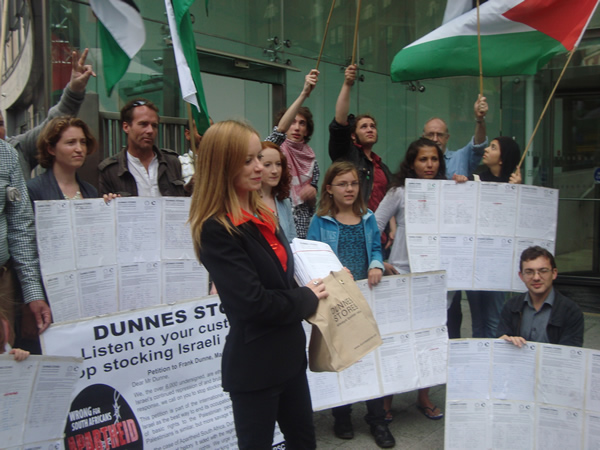
Freda Hughes IPSC Chairperson holding 6,000 signatures calling on Dunnes to stop stocking Israeli produce

"Dunnes was on the wrong side of history, siding with the South African apartheid regime against its own workers,"  Freda Hughes, IPSC Chairperson, said. "This is a chance for it to put itself on the right side of history. Israel's treatment of Palestinians amounts to nothing short of Apartheid. We must not ignore the lessons of South Africa and how apartheid was ended there – essentially it jumped before it was pushed. The boycott campaign can, and should, be used to isolate Israel both figuratively and literally until such a time as it complies fully with international law and ends its Apartheid regime in Palestine. We are not asking consumers to boycott Dunnes Stores. We are asking Dunnes Stores, and consumers islandwide, to boycott Israeli goods and services. This campaign is not designed to negatively affect Irish jobs."

IPSC activists collect signatures in Sligo (July 10)

Ms. Hughes
continued," We are delighted to see representatives from both the Palestinian and South African communities here today to show their solidarity and call for progressive steps to be taken in ending Israeli Aparthied and its abuse of human rights in the region. We are asking Dunnes to show its support for human rights and justice by refusing to stock Israeli goods just as the US chain-store Olympia Food Co-op in Washington State did last week."

Brendan Archbold
said, "The parallels between the old Apartheid regime of South Africa and the state of Israel are quite striking. Just as South African forces shot and killed their own people in Sharpeville and Uitenhage, so too do the Israeli military adopt a shoot-to-kill policy whether it is in relation to the Palestinian people themselves or those peaceful supporters of the Palestinians aboard the international flotilla recently attacked by Israel."
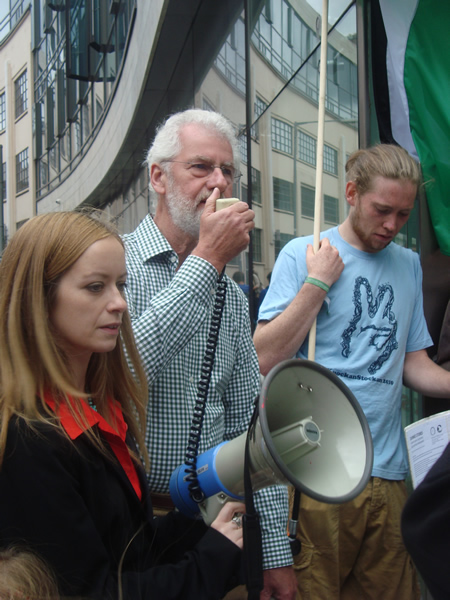

Brendan Archbold calls for Dunnes to boycott Israeli produce


Aengus O'Snodaigh spoke of his support for this campaign and said,"Israel has a long history of human rights abuses against the people of Palestine, and it believes it is beyond reproach for its apartheid policies. Israel needs to understand there are political and economic consequences for its crimes, and a consumer and retailer boycott of Israeli goods is an important aspect of holding Israel to account. I support this petition, but also call on the Irish and other European governments to suspend Israel's preferential trading status with the EU under the Euro-Med Agreement."

The petition campaign is part of a coordinated international effort for Boycott, Divestment and Sanctions (BDS) against Israel, which has seen actions take place in dozens of countries, including Israel and South Africa. Many South African organisations, and figures including Archbishop Desmond Tutu, have endorsed the BDS campaign.
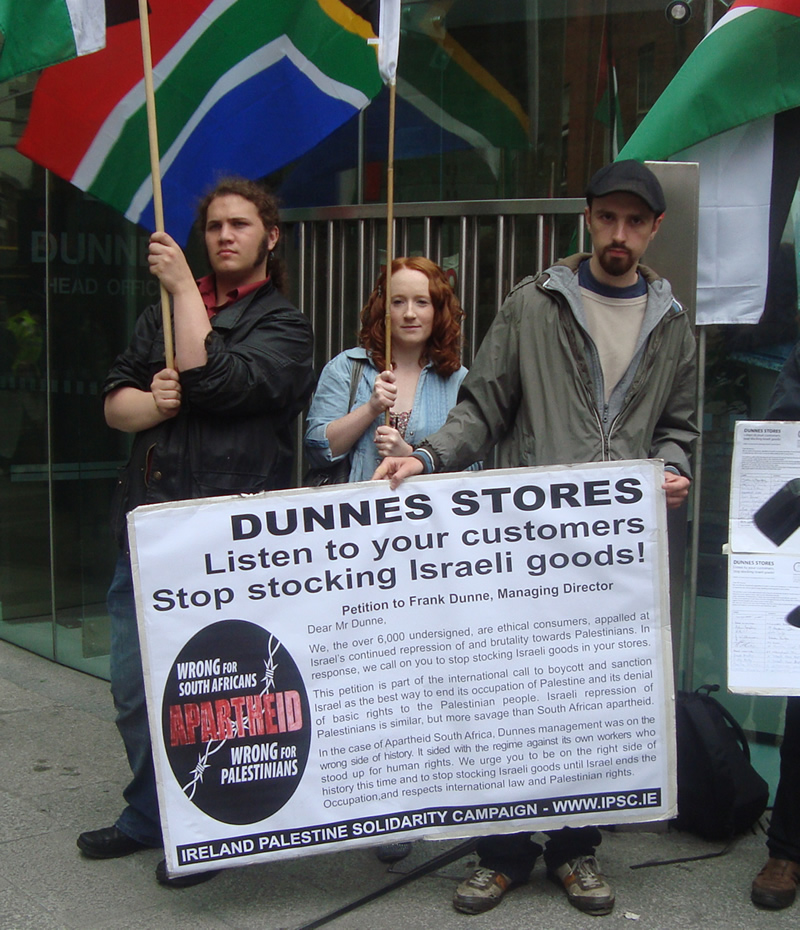

Members of the Palestinian and South African communities attended the hand-in today 
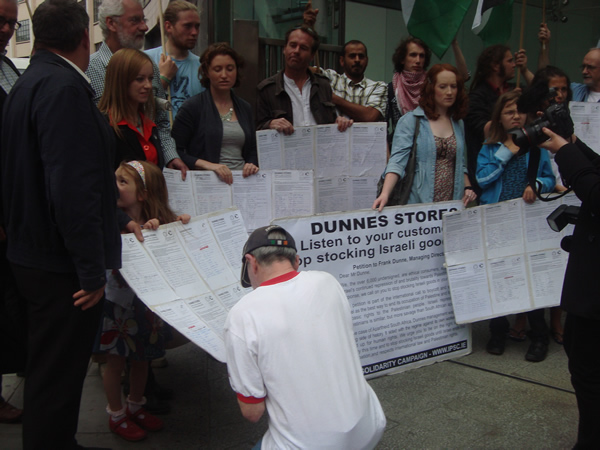
Members of the Palestinian and South African communities attended the hand-in today

Passer by stops to sign the petition before it is handed in

For more information on the Camapign of Boycott Divestment & Sanctions (BDS) against Israel and on the activities of the IPSC please click here

Monday, July 19, 2010

Remembering Dunnes Stores Strike - 26 Years on


Twenty six years ago today (July 19 1984) 21-year old cashier Mary Manning was suspended by management at the Henry Street branch of Dunnes stores where she worked. Two days earlier, Mary and her worker colleagues received a directive from their union IDATU (Irish Distributive and Administrative Trade Union) not to handle any products that originated from South Africa. This was as a consequence of a motion adopted at the IDATU annual delegate conference in April 1984. That motion said that because of the apartheid system, union members were to refuse to handle South African goods.


Karen Gearon, who was the IDATU shop steward within the store, passed the directive around to her colleagues. When Management at the branch became aware of this directive, they attempted to intimidate the workers into continuing to handle the relevant products but they took no specific measures against staff. However on July 19, that all changed. Management told employees that they must handle South African goods or severe disciplinary action would be taken against them.

Despite these threats, Mary Manning refused to handle two South African Outspan oranges that a customer brought to the checkout she was working at. She was immediately summoned by management and given five minutes to reconsider her position. She stood her ground, refused to breach the union directive and insisted to management she would not handle any South African goods. She was immediately suspended. 

 
Ten of Mary's fellow employees walked off the job in solidarity with her. They were Catherine O'Reilly, Karen Gearon, Theresa Mooney, Vonnie Munroe, Sandra Griffin, Alma Russell, Michelle Gavin, Liz Deasy, Dorothy Dooley and Tommy Davis. They were joined the following year by Brendan Barron who worked in the Crumlin branch of Dunnes Stores. 

 
So commenced a strike that did not end for more than two years and nine months. Despite all the odds stacked against them, despite the personal sacrifices that they had to make, they remained united and persisted with their action until the Dublin government finally decided to ban all South African goods from stores in the 26-counties in April 1987. 

 
Many of the strikers fell into ill health as a result of the constant picketing outdoors throughout that whole period including times of extreme weather conditions. Some lost their homes as a result of being unable to keep up their mortgage payments.

They suffered intense harassment by management at Dunnes, by companies who supplied Dunnes and by the Gardai. Indeed on a number of occasions, some of the women strikers had to get hospital treatment for injuries sustained as a result of Garda and management violence against them. 

 
But they refused to be beaten and grew stronger in their determination as each day passed. They took their fight to both the national and international stage, with both Karen Gearon and Michelle Gavin going as far as addressing the United Nations Special Committee on Apartheid in New York.

The lessons from this dispute for workers and trade unionists are many. The relevance of these lessons are as important, if not more so, today as Trade Unionism in Ireland is at its lowest ebb in decades.  This follows years of capitulation to government and business through the so-called partnership agreements and the recent Croke Park agreement on pay and reform in the public sector.


Despite these setbacks, all is not lost.  The strike and the resilience of these workers shows  us all the vast potential that exists within trade unions and what can be achieved when workers unite and remain united and determined to achieve their aims. It shows how essential the strike, the withdrawal of labour, is for workers. 

 
It also shows the necessity of worker and trade union solidarity with others as opposed to just looking after sectional interests. As the motto of the Industrial Workers of the World (IWW) goes, 'an injury to one is an injury to all', a line the present so-called 'leadership' of the Trade Union movement here in Ireland would do well to reflect upon and act upon.


Trade Unionism is about protecting workers in the workplace in terms of their wages and conditions of employment. But it is also about far more than that, something which the Dunnes Stores strikers represented and which the likes of ICTU have long since abandoned. 

 
This principled stance taken by these workers revealed the power that they and all workers have and how a strike and trade union solidarity can bring about significant political change. The withdrawal of labour is a tool feared by governments and business alike for they know the power that workers have if they utilise it properly. Sadly it appears that the likes of David Begg and others in ICTU fear it just as much as governments and employers.

Let no-one be under any illusion, this dispute played a major role in forcing the Dublin government to ban South African goods, a move that was extremely important in isolating South Africa economically.

Two years ago, a plaque was embedded in front of Dunnes's store on Henry Street to commemorate the strike and the workers who participated in it. Speaking at the ceremony, Kadar Asmal who had been Chairperson of the Irish Anti-Apartheid Movement during the strike and who went on to become a Minister in post Apartheid South Africa delivered a message on behalf of former South African President Nelson Mandela. 

 
According to Mandela “young workers who refused to handle the fruits of apartheid 21 years ago in Dublin provided inspiration to millions of South Africans that ordinary people far away from the crucible of apartheid cared for our freedom". 

 
South Africa's ambassador to Ireland, Priscilla Jana, described the strike as "one of the longest, most bitter and one of the most profound acts of solidarity" in the struggle to bring an end to apartheid.

"These brave men and women were in the prime of their youth then. No ego, no glory, no personal gains, just a dogged determination to fight against what they believed was unjust, unfair and inhuman" she said.

The strike ended in 1987, more than 23 years ago. But the tactic of boycott remains as relevant today as it did then. While the apartheid regime of South Africa has been long consigned to history, the apartheid state of Israel continues to deny human rights and freedom to the Palestinian people.

Palestinian civil society, including trade unions, have called for a campaign of Boycott, Divestment and Sanctions (BDS) against Israel, similar to that which played a large part in bringing the South African apartheid regime to an end.

In recent years ICTU have adopted numerous resolutions demanding a boycott of Israeli goods in solidarity with the Palestinian people in their struggle for an end to the Israeli occupation and the creation of a Palestinian state. Now those words need to be followed up by actions similar to those of the Dunnes Stores workers in 1984.

Amongst those around the world supporting the boycott against Israel are South African workers and trade unions. The South African Transport and Allied Workers’ Union, (SATAWU) which refuses to handle Israeli goods at South African ports, described recent actions by the Swedish Portworkers’ Union, who called a boycott of all Israeli ships and cargo from June 15 through to June 24, as “the kind of powerful workers’ action that was used during the fight against the South African apartheid regime and helped bring it down. It must be used again today against this criminal apartheid regime in Israel.” 

 
So 26 years on from the commencement of the Dunnes Stores strike, let us remember their sacrifice and bravery. But let us also commit to ensuring that the boycott of Israeli goods is now stepped up until sanctions are imposed and the Palestinian people secure their freedom. The Dunnes stores strikers made a difference in relation to South Africa. We can now do the same for the people of Palestine.


Thursday, July 8, 2010

Dont Fund Israeli War Crimes - Boycott Israeli Goods

This weekend (July 9-11) is International Boycott Sanctions & Divestment (BDS) Weekend against Israel. Here in Ireland, to mark the occasion, the IPSC (Ireland Palestine Solidarity Campaign) are launching a nationwide petition calling on Dunnes Stores to cease stocking Israeli goods in their stores.

This petition and actions surrounding it are in support and solidarity with up to 200 organisations from within Palestinian civil society who have pleaded with the international community to endorse the call for a campaign of boycott, divestment and sanctions against Israel, similar to that which helped to end the apartheid regime in South Africa. These organisations include Palestinian trade unions, professional bodies such as all the academic unions and associations, medical unions, and most of the major NGOs.
The Palestinian people continue to endure terrible suffering and brutal repression at the hands of the Israeli regime on a daily basis. The illegal occupation of the West Bank, theft of Palestinian land and resources, the continued expansion of illegal settlements and the construction of their apartheid wall continues unabated. Despite Israel's claims that they have somehow 'eased' their illegal siege of Gaza, their unhumane blockade and clear violation of international law continues.

This deliberate policy, coupled with the devestation caused to the infrastructure of Gaza during Operation Cast Lead last year when they slaughtered more than 1400 people, more than three hundred of whom were children, has resulted in the complete collapse of the Gazan economy and extensive and unnecessary illness and deaths, particularly among the young and elderly.

Let no-one be under any illusion – the suffering endured by the civilian population in Gaza is no accident. Neither is it a case of them being 'caught in the middle' as Israel targets Hamas as some might suggest.

No, the siege itself, like Israel's policy towards the Palestinians generally, is targetted specifically at the civilian population. By Israel's own admission, the blockade has a primarily political, as opposed to military objective, which is to put pressure on the civilian population of the Gaza Strip in order to influence Hamas.
 

Former Israeli Deputy Defense Minister M.K. Matan Vilnai equated the closure of Gaza with the achievement of changes in Hamas 'behaviour': He said that Israel would need “to reduce the scope of goods and thus create pressure on the Hamas organization, which is deliberately failing to take steps to advance the negotiation."

According to a senior Israeli government adviser Dov Weisglass the idea was “to put Palestinians on a diet but not to make them die of hunger”.

It is a clear cut case of collective punishment being imposed on a civilian population completely at odds with international law.


Article 33 of the Fourth Geneva Genvention is crystal clear on such matters. It says: “No protected person (civilian) may be punished for an offence he or she has not personally committed. Collective penalties and likewise all measures of intimidation or of terrorism are prohibited.”

Yet despite this, the US and the EU have welcomed Israel's 'easing' of the siege, which is nothing more than a PR stunt to divert attention away from massacre of humanitarian activists on board the Gaza aid flotilla. Once again they seem to ignore Israel's blatant contempt for International law and basic human rights for Palestinians. They need to be reminded that only a complete and total end to the blockade is acceptable under international law and to the Palestinian people.

The Palestine Center for Human Rights (PCHR) have already expressed their concerns over some international reaction to Israel's move. Raji Sourani, Director of PCHR, said that “the siege has transformed the Gaza Strip into an animal farm. The risk is that Gaza is just passing to another form of illegal blockade, one that may become internationally accepted and institutionalized."

The EU and US have also conveniently and shamefully ignored the litany of war crimes carried out by Israel, most notably those carried out during their month long murderous assault on Gaza last year and the more recent massacre of humanitarian activists on the Gaza aid flotilla. 
 

Specifically where the Dublin government are concerned, they have turned a blind eye and failed to take any action against Israel.   This is despite the fact that Israel engaged in the hi-jacking and kidnapping of Irish citizens on board Challenger 1 and the MV Rachel Corrie who they subsequently assaulted and ill treated while in captivity. Yet at the time at their kidnapping, Brian Cowen warned  that Israel would face “serious consequences” if any Irish citizens were injured. True to form, but shameful nonetheless, this Fianna Fáil led administration have so far refused to take any action whatsoever against the zionist regime.

In a briefing document distributed to members of the Leinster House Joint Committee on European Affairs on June 21, the IPSC proposed the following steps that the Dublin government need to take in relation to Palestine and Israeli War Crimes

(1)End its arms trade with Israel, e.g. the purchase of helmets and bullets from Israeli firms

(2) Support the suspension of the Euro-Mediterranean Association Agreement until Israel complies with international law

(3) Ensure that the ‘silent upgrade’ of EU-Israeli relations is halted until Israel complies with international law

(4) Work to reverse Israel's premature accession to the OECD

(5) Withdraw its ambassador from Tel Aviv as other countries have done, and expel the Israeli ambassador to Ireland. "Symbolic" actions such as the expulsion of a minor security official from the Israeli Embassy are insufficient.

(6) Oppose Israel's plan to hold an "internal" inquiry into its own actions against the Gaza Flotilla and support the holding of a genuinely impartial international inquiry.

(7) Exercise pressure on Irish multinational CRH to divest from its Israeli subsidiary that is engaged in building the Separation Wall deemed illegal by the International Court of Justice in 2005.

However, it is not just campaign groups or politicians that can make a difference or influence the situation. This Boycott campaign is an opportunity for every individual to express their abhorrence at the crimes committed by the Israeli state and to show support for the rights of Palestinian people to secure peace, justice and freedom. But more importantly, it is an opportunity for people to take practical measures that can have a real and positive effect, similar to what happened with the boycott of apartheid-era South African goods.

Support International Boycott Weekend by signing the IPSC petition, distributing the petition if possible to friends, family, neighbours, work colleagues etc and contacting your local store to ask them to cease stocking Israeli goods.

The IPSC in Sligo will be leafletting and gathering signatures for the Boycott Israel petition this Saturday (July 10) in O'Connell Street, Sligo between 2pm an 4pm.  Everyone welcome. 

For more information on International Boycott Day, to get copies of the petition for distribution and to learn of further IPSC activities in your area click here or email info@ipsc.ie