Those attending Court 17 of the Criminal Courts of Justice in Dublin on Friday June 17 were given a master class on just how ‘justice’ in the Twenty-Six Counties is dispensed. It took District Court Judge McDonnell less than ninety minutes to throw the case against éirígí’s Daithí Mac An Mháistir out of court. Under normal circumstances this verdict would have been a cause for celebration for the accused, so why was it that it was the Gardaí in Court 17 that had smiles on their faces?

And why was it that a crucial piece of defence evidence - in the form of a tape recording from inside of Pearse Street Garda barracks – was handed by the courts to the Gardaí, despite the fact that the tape recording had not been played in court?
Anglo Irish Bank Protest May 15th 2010
To fully understand what happened on Friday 17th one has first to go back to May 15, 2010 when four éirígí activists staged an early morning protest on the roof of the front porch of the Anglo Irish Bank building on Dublin’s Stephens Green. Five hours into their protest the four, Ursula Ní Shionnain, Daithi Ó Riain, Robbie Fox and Eoin Ó Se were violently removed from the porch by the Gardaí.
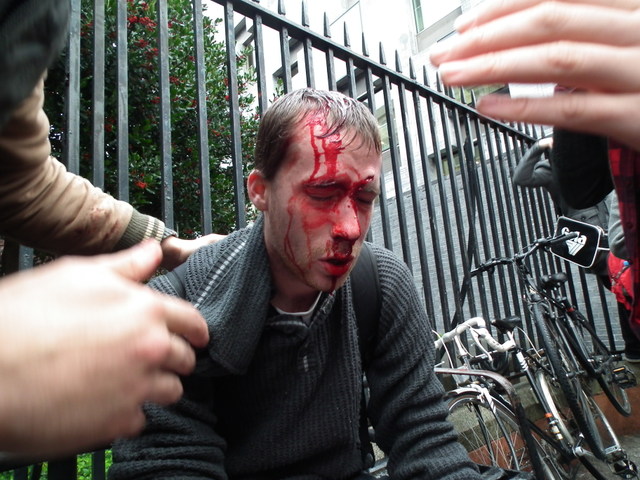
In the minutes that followed a further three people, John McCusker, Pádraig Ó Meiscill and Daithí Mac An Mháistir were arrested by baton-yielding Gardaí on the ground. All seven éirígí activists were then brought to Pearse Street Garda barracks before appearing in the Bridewell Court on a range of public order charges. While six of the accused were immediately released on bail, McCusker spent forty-eight hours in Clover Hill Prison at the behest of the Gardaí who claimed they were not satisfied that McCusker was who he said he was. Click here for a full report on the Anglo Irish protest of May 15, 2010.
McCusker and Ó Meiscill – Convicted and Appealed
On January 18th 2011 the case against McCusker and Ó Meiscill case was heard by Judge Watkins in the District Court in the Criminal Courts of Justice. Both men were charged under the controversial Public Order Act 1994, a piece of legislation which has attracted widespread criticism since it was introduced. In its prosecution the state failed to produce any video or photographic evidence, or any non-Garda witnesses.
In effect the case boiled down to whether the judge believed the word of the Gardaí or the word of the defendants. Despite the many inconsistencies and contradictions contained within the Garda evidence Judge Watkins chose to believe the Gardaí. But before convicting the two Belfast men she took the opportunity to call them liars and repeatedly question what business people from ‘outside the jurisdiction’ had attending a protest in Dublin. Both men immediately appealed their convictions, which have yet to be heard.

Ní Shionnain, Ó Riain, Fox and Ó Se – Case Thrown out of Court
On April 4th 2011 the case against the four people who had taken part in the protest on the roof of the porch of Anglo Irish Headquarters was heard. On this occasion the state alleged that Ní Shionnain, Ó Riain, Fox and Ó Se had breached Section 13 of the Public Order Act, by trespassing on the roof of the porch of the Anglo Irish Bank headquarters in a ‘manner as causes or is likely to cause fear in another person’. In reality the four had climbed onto the roof and erected a large banner with the words ‘People of Ireland Rise Up!’ emblazoned upon it.
During their trial a number of Garda and civilian witnesses gave testimony that was simply untrue, variously claiming that the protest represented a safety risk and that the four were aggressive, abusive and threatening. The opportunity to fully refute these untruths was denied to the defendants when the judge threw the case out of court before the defence had even begun.
As the prosecution presented its case it emerged that the porch roof constituted a ‘common area’ which all tenants of the building had the right to access. While the state brought representatives from Irish Life Assurance, which owns the building, and Anglo Irish Bank, which part occupy the building, it failed to bring a representative from ESB International, the second co-tenant of the building. Without a representative from ESB International in court to deny that the company had given the four éirígí activists permission to access the porch the judge had no option but to acquit the accused as the state had failed to prove beyond reasonable doubt that they were in fact trespassing.
Daithí Mac An Mháistir – The Prosecution, May 9th, 2011
Accused of breaching Section 6 of the Public Order Act, Daithí Mac An Mháistir was the last of the seven éirígí activists who had been charged on May 15th 2010 to be brought to trial. His trial was conducted over two days with the prosecution presenting their case on the afternoon of May 9th and the defence refuting the charges on June 17th.

The case against Mac An Mháistir was, like the cases against Ó Meiscill and McCusker, based exclusively on the testimony of a number of Garda witnesses. Despite the alleged offence having taken place at the rear of a bank headquarters on one of Dublin’s busiest streets the state failed to produce any video or photographic footage from Anglo Irish Bank, Dublin City Council, adjacent buildings or any other source. Stranger still the state failed to produce any Garda video or photographic evidence despite the fact that a number of Gardaí were using both video and stills camera’s throughout the May 15th protest.
Nor were any civilian witnesses brought in to back up the Garda allegations, even though the alleged offences took place on a bustling city street on a Saturday afternoon. So when the state accused Mac An Mháistir of ‘threatening, abusive or insulting words or behaviour with intent to provoke a breach of the peace or being reckless as to whether a breach of the peace may be occasioned’, it did so solely on the basis of the word of three Gardaí.
As is so often the case with Garda witnesses each of the three provided a strange mix of testimony, which was at times very definitive and yet at other times very vague. For example all three Garda witnesses recounted hearing the defendant shouting a range of colourful obscenities at the Garda line. And yet the same witnesses couldn’t hear, or couldn’t recall, what words Superintendant Joe Gannon had used when directing the protesters to move out of the way just minutes later. When asked if Gannon had used the correct formula of words when invoking Section 8 of the Public Order Act, or had Gannon just told people to get out of the way the Garda witnesses previously excellent powers of recall hit a convenient blind spot.

Another example of this schizophrenic recall saw each of the three Garda witnesses give a very precise recollection of seeing Mac An Mháistir step out of the line of protesters and ‘push’ or ‘shove’ Gannon, before running away. Yet the same witnesses had very vague recollections of if, when, why or how the Gardaí had drawn and used their batons against unarmed protesters.
One witness, a Garda O’Brien, who was capable of remembering that he had drawn his baton, was incapable of remembering why he or any of his colleagues hadn’t subsequently completed the requisite baton report form. Nor had he any recollection of hearing Superintendant Joe Gannon of Pearse Street tell him that there would blood spilled at the éirígí protest in the days before May 15th.
In previous cases involving éirígí activists, Garda witnesses have revealed special powers to rival those of the X-men, with extraordinary powers of recall and x-ray vision being the most common special powers. On this occasion the super-human hearing of Templemore’s finest was on display, when Garda O’Brien revealed that he was able to hear things that weren’t even said. He told the court that one of the four protesters on the porch roof had threatened to jump off if the Gardaí came any closer – a ridiculous claim that was met with open laughter from many in the public gallery.
In relation to the defendant’s arrest and the sequence of events directly prior to his arrest, each of the three Gardaí recounted near-identical versions of what they had claimed to have seen. Those sitting in the public gallery could have been forgiven for thinking that these testimonies had been scripted and rehearsed. The striking similarities between each of the Garda accounts were all the more remarkable when one understands that they collectively bore little resemblance to what actually happened, as borne out by contemporary photos and videos.
A Garda O’Riordan, the arresting officer, testified that she had witnessed a line of protesters and a line of Gardaí in a standoff; that the defendant had stepped out of the line of protesters to push Superintendant Gannon; that she had chased the defendant and grabbed his arm; that he had pushed her backwards and that Garda O’Brien had come to her assistance to effect the arrest.
When it was put to O’Riordan that the defendant had been put to the ground on three separate occasions by the Gardaí, she denied that this had happened. When it was put to the O’Riordan that she had put the defendant in a headlock she denied that this too had happened. And yet video footage from the protest clearly shows the defendant on the ground on three separate occasions and also shows the O’Riordan putting the defendant in a headlock.
By the time the prosecution had completed its deeply flawed case it was late afternoon, meaning that the defence could not be heard. Following a lengthy discussion June 17th emerged as the next available date that Judge McDonald, the state prosecutor and the defence were all available to complete the case.
But before the court rose the defence moved to admit an important piece of evidence on the basis that the relevant witness would not be able to attend the court on June 17th. When it emerged that the witness, Robert Sevcik was in possession of a tape recording from inside of Pearse Street Garda barracks the atmosphere within the court shifted dramatically. Now it was the turn of the state prosecutor and the Gardaí to start sweating.
When he took the stand Sevcik explained that he had taken part in an anti-fur protest outside of Barnardos furriers at the bottom of Grafton Street on the afternoon of May 15th 2010. During the course of the protest he had been arrested on public order offences by Gardaí based in Pearse Street. Prior to his arrest Sevcik had switched on a digital recording device which was subsequently taken from him when he was taken into Garda custody. When the device was returned to Sevcik a number of months later he discovered that the recording device had continued recording for a significant period of time inside of the Garda barracks.
Despite the best efforts of a clearly flustered state prosecutor to establish what exactly was on the tape the judge ruled that he would allow the tape recording to be played at the next court appearance on June 17. The disk which contained a copy of the recording was then placed in the care of the court registrar who was directed to lodge it in the court safe until June 17th.
Daithí Mac An Mháistir – The Defence, June 17th 2011
Those who are familiar with court procedures know that it is normal practice for all parties to be present in the court before the judge enters the chamber, which usually occurs on time. On the afternoon of June 17th, however, Judge McDonnell and a number of Gardaí witnesses were almost half an hour late arriving in court, an unusual occurrence which set the tone for what was to follow.

McDonnell aimed his first salvo at the defence, unusually demanding that any legal submissions be made at that point – prior to any element of the defence case being heard. When the defence questioned the legal basis for such a requirement he was instructed to leave the court to take direction from his client on the matter. Twenty minutes later the defence team and the accused returned to the court and informed the judge that they would not be making any submissions at this point, whilst reserving the right to make such submissions later in the case. If the judge thought that the defence were going to be bullied into making a submission which would allow him to throw the case out of court he was sadly mistaken.
Having failed to force the defence to make premature legal submissions McDonnell turned his attention to the state prosecutor, questioning the legal basis for the case being taken against the defendant. In a bizarre twist the Judge began to question at what point the defendant had been informed of the reason for his arrest.
It should be noted that this issue had not been raised at any prior point by the prosecution or the defence. In effect the judge was introducing an entirely new element to the case – an element which legal experts believe would have been instantly dismissed by McDonnell or any other District Court judge had it been introduced by the defence. Having himself introduced the issue of when the defendant was informed of the reasons for his arrest, the judge went on to dismiss the arguments of the state prosecutor and use the issue as the basis for throwing the entire case out of court.

Having stopped the case before the defence had even started; Judge McDonnell produced the disk which Sevcik had brought to court on May 9th, allegedly to ensure that it could be returned to Sevcik. A disk that contained recordings of conversations between Gardaí inside of Pearse Street barracks on the day of the Anglo Irish protest. A disk that the Gardaí had not heard and did not have access to. A disk that had been submitted by a defence witness who had himself been the victim of Garda harassment and abuse.
So how did Judge McDonnell propose to return the disk to Sevcik? By entrusting the disk to the Gardaí that were present in court – the very same Gardaí who had policed the protest at Anglo Irish Bank; the very same Gardaí who had forcibly removed the four éirígí protesters from the roof of the porch; the very same Gardaí who had attacked unarmed protesters with batons; the very same Gardaí who had arrested the seven éirígí activists; the very same Gardaí who can be heard on the tape recording from inside Pearse Street barracks.
Those sitting in the public gallery could hardly believe what was happening in front of them. And neither could the defence who informed the judge that the tape recording was to be used in two other cases at the Circuit Court and should therefore not be handed over to the Gardaí. A plea that fell on deaf ears.
And with that the disk was handed to Garda O’Brien, the baton-happy cop who had told the court that he had heard an éirígí activist threaten to jump off the roof during the May 15th protest. One thing is for certain – he won’t have needed his super powers to figure out which of his colleagues can be heard on the Pearse Street recording.
Before Judge McDonnell finished his day’s work he took the opportunity to take one final swipe at the defence when he declared that it had conducted itself in an ‘improper’ manner and that it was his belief that the case was to be used for ‘collateral’ reasons. Strange that he was able to draw these conclusions when the defence had been denied the opportunity to utter one word of a defence or outline how it intended to refute the charges that had been brought against Mac An Mháistir. Nor had the judge heard the Pearse Street recording. Yeah, sure he hadn’t!