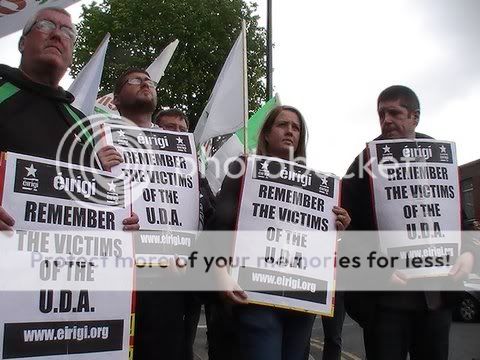
The second day of Elizabeth Windsor’s state visit to the Twenty-Six Counties saw éirígí activists and supporters staging protests at Islandbridge and Dublin Castle. The first protest was called after it was revealed that up to thirty leading members of the Ulster Defence Association had been invited to attend a wreath-laying ceremony in the Memorial Gardens in Islandbridge.
Before the protest even began, however, it was clear that the Gardaí were intent on provoking conflict. As éirígí Dublin City Councillor Louise Minihan arrived at the assembly point at Kilmainham Jail her car was pulled over and searched. During the course of the search a banner with the words ‘Fund Communities, Not Royal Visits!’ was seized on the spurious grounds of it being “offensive material”. A video of the search can be seen below.
By the time the Gardaí had completed their search of Minihan’s car a force of at least forty Gardaí had assembled outside of the building where the leaders of the 1916 rising were executed. There is little doubt that those brave men would have been disgusted at the prospect of the British Head of State and her UDA henchmen being afforded such an extravagant welcome by the Dublin government.
With Windsor now in the Memorial Gardens the thirty or so protesters made their way along Inchicore Road with the intention of demonstrating at the junction of Memorial Road and the N4. But this was not to be, as the Gardaí blocked access to Memorial Road with a line of rapidly deployed boys in yellow. When questioned on the legality of his impromptu roadblock, the commanding Garda replied that he was acting under the provisions contained within Section 21, a phrase that was becoming all too familiar to people across Dublin.
With their preferred route to the Memorial Gardens blocked the protesters returned to Kilmainham Jail to lay a wreath in memory of the victims of the UDA, before making a second attempt to access the Gardens. On this occasion upwards of 100 Gardaí were deployed to block the junction of South Circular Road and the N4. Although not as close to the Memorial Gardens as had been originally intended, the protesters’ voices, whistles and bodhráns loudly proclaimed their opposition to the mass murderers of the UDA.
While the protest may not have been particularly large that did not diminish from the hugely important principle upon which is was based; that it was morally bankrupt for the Twenty-Six County authorities to invite the leaders of one of the most vicious of unionist death squads to Dublin. As befitting an act of solidarity with the victims of the UDA, the protest was conducted with discipline and dignity throughout, despite the provocations of the state’s bully-boys.
éirígí Sligeach activist Gerry Casey, who was among those taking part in the demonstration at Islandbridge, slammed the actions of the Gardai in attempting to prevent legitimate peaceful protests as "beneath contempt".
Casey said: "It is highly ironic that those of us protesting against the presence of the UDA at Islandbridge are intimidated and threatened while those unionist death squad leaders are received as special guests complete with Garda protection. Even more so was the fact that Gardai siezed a 'fund communities not royal visits' banner from the car of Cllr Louise Minihan on the basis that it was somehow 'offensive'."
"What was really offensive was not a political banner but the presence of the UDA death squads and the role of the Gardai in attempting to prevent our protest. Their intimidation of protesters by issuing threats to arrest searching cars and individuals, seizing political material, manhandling people and trying to prevent photos and video footage being taken was beneath contempt."
Casey concluded: "Once again the Gardai have shown themselves as a political police force who have no hesitation in breaking their own laws in order to protect the interests of the political and business elite in this state. They also have put the interests of the British state and their proxies in the unionist death squads before the interests of the citizens of this state, in particular the families of the victims of collusion who continue to seek justice for their loved ones."
Tuesday’s [May 17] day of protest against the state visit of Elizabeth Windsor began on O’Connell Street when a group of éirígí activists and supporters staged an impromptu sit-down protest beside the Spire monument. As Windsor left Casement Aerodrome, on the outskirts of the city, the chants of ‘Can you hear us loud and clear? British royals not welcome here!’ and ‘Whose streets? Our streets?’ were echoing off the historic GPO.
As more activists arrived with flags and megaphones the face of the Gardaí said it all. Despite the massive security operation that had been put in place it was clear that the voice of Irish republicanism was going to be loudly heard in the centre of Dublin. By the time Gardaí formed a line to prevent further supporters joining the protest there were already thirty people sitting on the ground, with more arriving by the minute.
Within ten minutes of the action starting there were two groups of protesters in place – one on the otherwise deserted central plaza of Dublin’s main thoroughfare and one hemmed behind the police line at the top of Henry Street. With roughly two hours remaining until Windsor’s scheduled arrival on O’Connell Street scores of Gardaí began to forcibly push protesters back down Henry Street.
When that task was completed another large force of Gardaí prepared to move on the activists sitting beside the Spire. In the face of certain arrest and removal from the streets for the duration of the Garden of Remembrance ceremony, the group of activists made their way en bloc to their comrades at the top of Moore Street.
The professionalism of the Garda was to the fore as the various top brass starting issuing contradictory orders to various sections of their yellow-coated goons. So as some Gardaí tried to arrest the protesters others opened the police line to let them onto Henry Street, and yet more started pushing protesters back down the street!
The chaotic scenes continued for roughly five minutes before the now 150-strong group of éirígí activists and supporters made their way to 16 Moore Street for a wreath-laying ceremony. The protest had lasted over half an hour, during which time hundreds of onlookers and dozens of journalists had witnessed both the dignity of the protesters and the aggression of the Gardaí.
At 16 Moore Street éirígí ‘s Ursula Ní Shionnain gave a brief speech prior to the laying of a wreath in memory of all of those who have died for Irish freedom, which was followed by a minute’s silence. With the ceremony complete the large and very loud protest moved onwards towards the Garda line at the corner of Parnell Square. Once there, the entire crowd sat down on the road where they remained for close to two hours in a remarkable demonstration of dignified and disciplined political protest.
Those who found themselves sitting on Parnell Street were an unusual mix of seasoned political activists, school children, university students, workers, the unemployed and those who call the streets of the north inner city home. For almost two hours they sang rebel songs, chanted anti-royal slogans, blew whistles and banged drums – united in their opposition to Windsor and all that she represents.
Despite the oppressive security operation and the ample provocation of Windsor’s presence in the Garden of Remembrance, the ever-swelling crowd did not walk into the trap that the forces of the state had laid for them. Instead they maintained a dignified and disciplined protest which succeeded in its objective.
Footage of the protest was beamed around the world by Sky News and other multi-national news stations. The message was unmistakable – Windsor is not welcome; Britain out of Ireland. In countless radio, television and print interviews éirígí spokespeople hammered home that same message again and again. And when Windsor finally arrived at the Garden of Remembrance the noise of the protest was deafening as hundreds of voices, whistles, drums and air-horns screamed their unmistakable opposition to the British Empire.
Although Windsor, and the apologists that joined her, may not have seen any protesters they most certainly heard them, a fact confirmed by journalists who were in the Garden and those who could hear the protest as far away as Denmark Street. All in all, it was a most unusual and most successful protest – one that sat in perfect harmony with the anti-royal protests of Connolly and Markievicz one hundred years before hand.