Showing posts with label Dublin. Show all posts

Sunday, June 26, 2011

Fifth Anglo Irish Protester’s Case Thrown out of Court

Justice – Twenty-Six County Style

Those attending Court 17 of the Criminal Courts of Justice in Dublin on Friday June 17 were given a master class on just how ‘justice’ in the Twenty-Six Counties is dispensed. It took District Court Judge McDonnell less than ninety minutes to throw the case against éirígí’s Daithí Mac An Mháistir out of court. Under normal circumstances this verdict would have been a cause for celebration for the accused, so why was it that it was the Gardaí in Court 17 that had smiles on their faces?


And why was it that a crucial piece of defence evidence - in the form of a tape recording from inside of Pearse Street Garda barracks – was handed by the courts to the Gardaí, despite the fact that the tape recording had not been played in court?


Anglo Irish Bank Protest May 15th 2010

To fully understand what happened on Friday 17th one has first to go back to May 15, 2010 when four éirígí activists staged an early morning protest on the roof of the front porch of the Anglo Irish Bank building on Dublin’s Stephens Green. Five hours into their protest the four, Ursula Ní Shionnain, Daithi Ó Riain, Robbie Fox and Eoin Ó Se were violently removed from the porch by the Gardaí.


In the minutes that followed a further three people, John McCusker, Pádraig Ó Meiscill and Daithí Mac An Mháistir were arrested by baton-yielding Gardaí on the ground. All seven éirígí activists were then brought to Pearse Street Garda barracks before appearing in the Bridewell Court on a range of public order charges. While six of the accused were immediately released on bail, McCusker spent forty-eight hours in Clover Hill Prison at the behest of the Gardaí who claimed they were not satisfied that McCusker was who he said he was. Click here for a full report on the Anglo Irish protest of May 15, 2010.


McCusker and Ó Meiscill – Convicted and Appealed

On January 18th 2011 the case against McCusker and Ó Meiscill case was heard by Judge Watkins in the District Court in the Criminal Courts of Justice. Both men were charged under the controversial Public Order Act 1994, a piece of legislation which has attracted widespread criticism since it was introduced. In its prosecution the state failed to produce any video or photographic evidence, or any non-Garda witnesses.


In effect the case boiled down to whether the judge believed the word of the Gardaí or the word of the defendants. Despite the many inconsistencies and contradictions contained within the Garda evidence Judge Watkins chose to believe the Gardaí. But before convicting the two Belfast men she took the opportunity to call them liars and repeatedly question what business people from ‘outside the jurisdiction’ had attending a protest in Dublin. Both men immediately appealed their convictions, which have yet to be heard.


Ní Shionnain, Ó Riain, Fox and Ó Se – Case Thrown out of Court

On April 4th 2011 the case against the four people who had taken part in the protest on the roof of the porch of Anglo Irish Headquarters was heard. On this occasion the state alleged that Ní Shionnain, Ó Riain, Fox and Ó Se had breached Section 13 of the Public Order Act, by trespassing on the roof of the porch of the Anglo Irish Bank headquarters in a ‘manner as causes or is likely to cause fear in another person’. In reality the four had climbed onto the roof and erected a large banner with the words ‘People of Ireland Rise Up!’ emblazoned upon it.


During their trial a number of Garda and civilian witnesses gave testimony that was simply untrue, variously claiming that the protest represented a safety risk and that the four were aggressive, abusive and threatening. The opportunity to fully refute these untruths was denied to the defendants when the judge threw the case out of court before the defence had even begun.


As the prosecution presented its case it emerged that the porch roof constituted a ‘common area’ which all tenants of the building had the right to access. While the state brought representatives from Irish Life Assurance, which owns the building, and Anglo Irish Bank, which part occupy the building, it failed to bring a representative from ESB International, the second co-tenant of the building. Without a representative from ESB International in court to deny that the company had given the four éirígí activists permission to access the porch the judge had no option but to acquit the accused as the state had failed to prove beyond reasonable doubt that they were in fact trespassing.


Daithí Mac An Mháistir – The Prosecution, May 9th, 2011

Accused of breaching Section 6 of the Public Order Act, Daithí Mac An Mháistir was the last of the seven éirígí activists who had been charged on May 15th 2010 to be brought to trial. His trial was conducted over two days with the prosecution presenting their case on the afternoon of May 9th and the defence refuting the charges on June 17th.


The case against Mac An Mháistir was, like the cases against Ó Meiscill and McCusker, based exclusively on the testimony of a number of Garda witnesses. Despite the alleged offence having taken place at the rear of a bank headquarters on one of Dublin’s busiest streets the state failed to produce any video or photographic footage from Anglo Irish Bank, Dublin City Council, adjacent buildings or any other source. Stranger still the state failed to produce any Garda video or photographic evidence despite the fact that a number of Gardaí were using both video and stills camera’s throughout the May 15th protest.


Nor were any civilian witnesses brought in to back up the Garda allegations, even though the alleged offences took place on a bustling city street on a Saturday afternoon. So when the state accused Mac An Mháistir of ‘threatening, abusive or insulting words or behaviour with intent to provoke a breach of the peace or being reckless as to whether a breach of the peace may be occasioned’, it did so solely on the basis of the word of three Gardaí.


As is so often the case with Garda witnesses each of the three provided a strange mix of testimony, which was at times very definitive and yet at other times very vague. For example all three Garda witnesses recounted hearing the defendant shouting a range of colourful obscenities at the Garda line. And yet the same witnesses couldn’t hear, or couldn’t recall, what words Superintendant Joe Gannon had used when directing the protesters to move out of the way just minutes later. When asked if Gannon had used the correct formula of words when invoking Section 8 of the Public Order Act, or had Gannon just told people to get out of the way the Garda witnesses previously excellent powers of recall hit a convenient blind spot.

 
Another example of this schizophrenic recall saw each of the three Garda witnesses give a very precise recollection of seeing Mac An Mháistir step out of the line of protesters and ‘push’ or ‘shove’ Gannon, before running away. Yet the same witnesses had very vague recollections of if, when, why or how the Gardaí had drawn and used their batons against unarmed protesters.


One witness, a Garda O’Brien, who was capable of remembering that he had drawn his baton, was incapable of remembering why he or any of his colleagues hadn’t subsequently completed the requisite baton report form. Nor had he any recollection of hearing Superintendant Joe Gannon of Pearse Street tell him that there would blood spilled at the éirígí protest in the days before May 15th.


In previous cases involving éirígí activists, Garda witnesses have revealed special powers to rival those of the X-men, with extraordinary powers of recall and x-ray vision being the most common special powers. On this occasion the super-human hearing of Templemore’s finest was on display, when Garda O’Brien revealed that he was able to hear things that weren’t even said. He told the court that one of the four protesters on the porch roof had threatened to jump off if the Gardaí came any closer – a ridiculous claim that was met with open laughter from many in the public gallery.


In relation to the defendant’s arrest and the sequence of events directly prior to his arrest, each of the three Gardaí recounted near-identical versions of what they had claimed to have seen. Those sitting in the public gallery could have been forgiven for thinking that these testimonies had been scripted and rehearsed. The striking similarities between each of the Garda accounts were all the more remarkable when one understands that they collectively bore little resemblance to what actually happened, as borne out by contemporary photos and videos.


A Garda O’Riordan, the arresting officer, testified that she had witnessed a line of protesters and a line of Gardaí in a standoff; that the defendant had stepped out of the line of protesters to push Superintendant Gannon; that she had chased the defendant and grabbed his arm; that he had pushed her backwards and that Garda O’Brien had come to her assistance to effect the arrest.


When it was put to O’Riordan that the defendant had been put to the ground on three separate occasions by the Gardaí, she denied that this had happened. When it was put to the O’Riordan that she had put the defendant in a headlock she denied that this too had happened. And yet video footage from the protest clearly shows the defendant on the ground on three separate occasions and also shows the O’Riordan putting the defendant in a headlock.


By the time the prosecution had completed its deeply flawed case it was late afternoon, meaning that the defence could not be heard. Following a lengthy discussion June 17th emerged as the next available date that Judge McDonald, the state prosecutor and the defence were all available to complete the case.


But before the court rose the defence moved to admit an important piece of evidence on the basis that the relevant witness would not be able to attend the court on June 17th. When it emerged that the witness, Robert Sevcik was in possession of a tape recording from inside of Pearse Street Garda barracks the atmosphere within the court shifted dramatically. Now it was the turn of the state prosecutor and the Gardaí to start sweating.


When he took the stand Sevcik explained that he had taken part in an anti-fur protest outside of Barnardos furriers at the bottom of Grafton Street on the afternoon of May 15th 2010. During the course of the protest he had been arrested on public order offences by Gardaí based in Pearse Street. Prior to his arrest Sevcik had switched on a digital recording device which was subsequently taken from him when he was taken into Garda custody. When the device was returned to Sevcik a number of months later he discovered that the recording device had continued recording for a significant period of time inside of the Garda barracks.


Despite the best efforts of a clearly flustered state prosecutor to establish what exactly was on the tape the judge ruled that he would allow the tape recording to be played at the next court appearance on June 17. The disk which contained a copy of the recording was then placed in the care of the court registrar who was directed to lodge it in the court safe until June 17th.


Daithí Mac An Mháistir – The Defence, June 17th 2011

Those who are familiar with court procedures know that it is normal practice for all parties to be present in the court before the judge enters the chamber, which usually occurs on time. On the afternoon of June 17th, however, Judge McDonnell and a number of Gardaí witnesses were almost half an hour late arriving in court, an unusual occurrence which set the tone for what was to follow.


McDonnell aimed his first salvo at the defence, unusually demanding that any legal submissions be made at that point – prior to any element of the defence case being heard. When the defence questioned the legal basis for such a requirement he was instructed to leave the court to take direction from his client on the matter. Twenty minutes later the defence team and the accused returned to the court and informed the judge that they would not be making any submissions at this point, whilst reserving the right to make such submissions later in the case. If the judge thought that the defence were going to be bullied into making a submission which would allow him to throw the case out of court he was sadly mistaken.


Having failed to force the defence to make premature legal submissions McDonnell turned his attention to the state prosecutor, questioning the legal basis for the case being taken against the defendant. In a bizarre twist the Judge began to question at what point the defendant had been informed of the reason for his arrest.


It should be noted that this issue had not been raised at any prior point by the prosecution or the defence. In effect the judge was introducing an entirely new element to the case – an element which legal experts believe would have been instantly dismissed by McDonnell or any other District Court judge had it been introduced by the defence. Having himself introduced the issue of when the defendant was informed of the reasons for his arrest, the judge went on to dismiss the arguments of the state prosecutor and use the issue as the basis for throwing the entire case out of court.


Having stopped the case before the defence had even started; Judge McDonnell produced the disk which Sevcik had brought to court on May 9th, allegedly to ensure that it could be returned to Sevcik. A disk that contained recordings of conversations between Gardaí inside of Pearse Street barracks on the day of the Anglo Irish protest. A disk that the Gardaí had not heard and did not have access to. A disk that had been submitted by a defence witness who had himself been the victim of Garda harassment and abuse.


So how did Judge McDonnell propose to return the disk to Sevcik? By entrusting the disk to the Gardaí that were present in court – the very same Gardaí who had policed the protest at Anglo Irish Bank; the very same Gardaí who had forcibly removed the four éirígí protesters from the roof of the porch; the very same Gardaí who had attacked unarmed protesters with batons; the very same Gardaí who had arrested the seven éirígí activists; the very same Gardaí who can be heard on the tape recording from inside Pearse Street barracks.


Those sitting in the public gallery could hardly believe what was happening in front of them. And neither could the defence who informed the judge that the tape recording was to be used in two other cases at the Circuit Court and should therefore not be handed over to the Gardaí. A plea that fell on deaf ears.


And with that the disk was handed to Garda O’Brien, the baton-happy cop who had told the court that he had heard an éirígí activist threaten to jump off the roof during the May 15th protest. One thing is for certain – he won’t have needed his super powers to figure out which of his colleagues can be heard on the Pearse Street recording.


Before Judge McDonnell finished his day’s work he took the opportunity to take one final swipe at the defence when he declared that it had conducted itself in an ‘improper’ manner and that it was his belief that the case was to be used for ‘collateral’ reasons. Strange that he was able to draw these conclusions when the defence had been denied the opportunity to utter one word of a defence or outline how it intended to refute the charges that had been brought against Mac An Mháistir. Nor had the judge heard the Pearse Street recording. Yeah, sure he hadn’t!


Tuesday, June 14, 2011

Remembering the Republic’s Wild Geese

Click to enlargeOn Friday, July 15, éirígí will host a public meeting in the Teachers Club on Parnell Square, Dublin to mark the 75th anniversary of the start of the Spanish Civil War. Many Irish radicals, socialists and republicans of the 1930s worked hard to aid the Spanish Republic from the attacks of fascists.


Some in Ireland countered the right-wing media, while others travelled to the Spanish state to fight on the frontlines. While Eoin O’Duffy, the capitalist media and the Catholic Church supported oppression and murder, this band of Irish radicals fought as part of the International Brigades to defend democracy.


Before departing for the Spanish state, Frank Ryan made the following statement: “The Irish contingent is a demonstration of revolutionary Ireland’s solidarity with the gallant Spanish workers and peasants in their fight for freedom against fascism.


“It aims to redeem Irish honour besmirched by the intervention of Irish fascism on the side of Spanish fascist rebels. It is to aid the revolutionary movements in Ireland to defeat the fascist menace at home, and finally, and not the least, to establish fraternal bonds of kinship between the Republican democracies of Ireland and Spain.”


Ryan was an activist with a vast amount of experience. He had been active in the IRA in the Tan War, the Civil War and beyond and had played other prominent roles, including as director of organisation of Fianna Éireann and as editor of An Phoblacht. After helping to found the Republican Congress, he continued to lead the way for Irish socialist republicans.


Both the Congress campaign against slum landlords and the mobilisations to counter British imperialist displays on Armistice Day each November saw him physically lead the charge against the enemies of Ireland’s working class.


The unit he led to the Spanish state were no naïve youths either. They were experienced political activists, well aware that, in order to defeat imperialism and fascism, they must be challenged physically.


Speakers on the night will include established authorities on the period Emmet O’Connor [author and lecturer] and Harry Owens [historian]. The talk will be followed by a ska/reggae/punk disco, with full bar at the same venue.

Monday, May 30, 2011

Release of Garda exposes Corrupt Two - Tier 'Justice' System


 Last Thursday (May 26), Dean Foley was sentenced to 18 months imprisonment, with 12 months suspended, for assault. Foley, a serving Garda at the time of the attack, was convicted for a brutal unprovoked attack on Stephen Murphy in Cork.  Foley knocked Murphy unconscious and inflicted a series of horrific injuries on him. As a result, Murphy suffered bleeding to the brain, broken teeth and broken bones to his face.

However, the next day, despite the savage nature of the attack, the judge that sentenced him reconsidered that sentence and suspended all of it ensuring Foley's immediate release. In an extraordinary decision, the judge decided to keep Foley out of prison because as a Garda he would have a 'harder time' serving his sentence than an ordinary prisoner would.

Convicted Garda Dean Foley

If the situation had been reversed and Garda Foley had suffered this attack and injuries at the hands of a member of the public, the attacker would not be treated so leniently. The reality is that the perpetrator would be in a prison cell for the best part of a decade.

Coincidentally a young man who carried out an assault resulting in similar injuries was recently convicted at a court in County Clare and sentenced to 6 years in prison. So while this young man goes to jail for six years, Foley walks free despite the savage brutality of his crime solely because he was a member of the Gardai.

We have regularly seen Gardai act with impunity in breaking the law and in attacking peaceful protesters. For the past ten years at anti-Shell protests in Mayo Gardai have attacked peaceful protesters causing serious injuries and hospitalisation in many instances. (click here for article on policing in north Mayo)

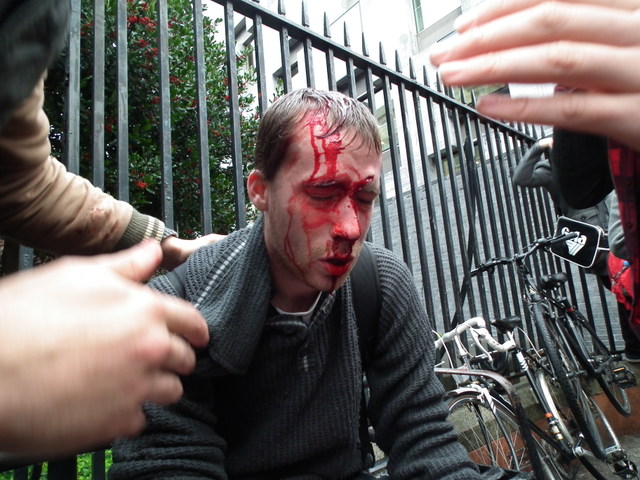
Victim of Garda assault at student anti-cuts demo
Such brutality are not isolated incidents. Gardai have been involved in attacking protesters on many other occasions including the 'Reclaim the Streets' demo a number of years back, éirígí's Anglo Irish Bank protest  in May of last year (click here) and the student anti-cuts protest in Dublin last November (click here).

We have seen the litany of other crimes committed by Gardai, including the planting of drugs as well as weapons and explosives, the manufacturing of false confessions and the deliberate framing of individuals as exposed by the Morris Tribunal  in Donegal.

All of the above are just the tip of the iceberg, yet how many Gardai have gone to jail for any of these offences? None.

On the other hand, those engaged in peaceful protest have regularly been imprisoned.  

Shell to Sea spokesperson Maura Harrington has been imprisoned on five separate occasions for her role in protesting against Shell's planned pipeline in north Mayo.

Pat O'Donnell after Garda Assault
Fellow campaigner Pat 'the chief' O'Donnell served five months out of a seven month sentence in Castlerea prison last year for public order offences relating to a cavalcade in support of Ms Harrington who was on hunger-strike at the time.

Many people who are unable to pay their debts or fines are regularly jailed despite the hardship inflicted on them and their families. In the first 10 months of 2010, 3,200 people were jailed in the twenty six counties for non-payment of debt.  No leniency or consideration is given by the courts and the so-called justice system as they despatch working class men and women to jail for extremely minor offences and inability to pay.

Yet here we have the extraordinary situation of a judge coming back into court the day after sending a brutal attacker to prison, to change his mind and let him go free solely because he was a Garda and might have a 'hard time' in prison.

Describing the decision as “shocking but not surprising” éirígí Sligeach activist Gerry Casey said it exposed the “corrupt and two-tier nature” at the heart of the twenty six county state's so-called 'justice' system.


Casey said: “This is a shocking decision to allow this criminal escape justice solely on the basis of him being a Garda. It gives Gardai and others in positions of authority within this state a green light to to abuse their positions and commit horrific crimes safe in the knowledge that they will not serve time.”

“While shocking, this judgement is not surprising considering the corrupt and two—tier nature of what passes for a 'justice system' in this state. It is extremely rare for a Garda to ever have to answer for his/her crimes before the courts. It is even rarer that justice is done on the seldom occasion that they do.”

"The Gardai, the courts and the 'justice system' are not there to provide justice for working people. It is there for one reason and one reason only - to serve and protect the interests of this state's elites."

Thursday, May 26, 2011

James Connolly, Monarchy & Labour Party Hypocrisy

The tweet below was posted by Labour party TD for East Galway Colm Keaveney on the first day of the Windsor visit and was reproduced in the Galway Independent newspaper the following day in its May 18th issue.


Below is the contents of a letter from éirígí Sligeach activist Gerry Casey in response to Keaveney's remarks which was published in yesterday's Galway Independent (May 25th).  Just click on the image below to read the digital edition or click here to read it on the papers website.


The following text is the full content of the response to Deputy Keaveney.


A chara

Please allow me to respond to the Labour TD Colm Keaveney's ill-informed tweet relating to the Windsor visit published in last weeks Galway Independent. In it he describes the socialist republican party éirígí as 'thugs'.

So what merits such a tag in Deputy Keaveney's eyes?

Is it upholding our right to organise a series of protests against the visit of the British head of state, all of which were peaceful despite huge provocation from Gardai? Is it our refusal to be intimidated by persistent Garda actions who, in the run-up and during the visit, intimidated and threatened activists engaged in legal political activity?

Party members erecting posters in Dublin, including myself, were illegally stopped and searched and interrogated by Gardai refusing to show ID or cite what act they were acting under as obliged by law. Despite having permits to poster, these were torn down and the remainder seized by Gardai.

éirígí Dublin City Cllr Louise Minihan had her car searched by up to a dozen Gardai who seized a banner that read 'Fund Communities Not Royal Visits' deeming it to be 'offensive'. Other similar banners and flags were also seized as Gardai tried to prevent peaceful protests taking place. I was grabbed from behind and thrown to the ground by Gardai as I videoed their attempts to prevent people joining a protest at the Spire.

While the Union Jack flew over government buildings, Gardai effectively banned our national flag from Dublin city centre, seizing tri-colours and throwing them in refuse trucks.

As someone who has watched Gardai police anti-Shell protests in north Mayo, this intimidation, illegality and blatant attempts to prevent peaceful protest does not surprise me. But if Deputy Keaveney is concerned about 'thugs' he would be better served taking on those 'thugs' for which his government are responsible i.e the Gardai. Or does Deputy Keaveney think that the right to engage in legal political activity and peaceful protest should only extend to other countries and not here?  Does he believe the thuggery outlined above is acceptable?


Is mise

Gerry Casey
éirígí Sligeach

Labour TD Colm Keaveney
Previously a full-time Trade Union official with SIPTU until his recent election to Leinster House, Keaveney and his colleagues in the Labour party would like us all to believe that they are following in the footsteps of James Connolly and James Larkin.

Speaking at Arbour Hill just two days before he welcomed the first English Monarch to visit the 26 counties in 100 years off her plane, Keaveney's party leader Eamon Gilmore said: 

"It is an occasion to honour the memory of a man who, through his ideals; through his vision; and through his sacrifice; bequeathed to us a living legacy. That legacy is the Labour Party."

Gilmore welcomes Windsor to Dublin
 
He added:

"So as we gather to celebrate the life of James Connolly - the values he stood for, the ideals he fought for - we might also reflect on our own call to duty."  

So what were those values of Connolly's that the Labour party leader wanted to celebrate?  What for instance were Connolly's views on Monarchy and of royal visits to Ireland?

Speaking in the advance of the last 'British royal' visit in 1911 Connolly made his views absolutely crystal clear "that the occasion will be utilised to make propaganda on behalf of royalty and aristocracy against the oncoming forces of democracy and National freedom".

James Connolly
 And in comments that could just as easily be directed now at Gilmore and Keaveney he said:

"Let the capitalist and landlord class flock to exalt him; he is theirs; in him they see embodied the idea of caste and class; they glorify him and exalt his importance that they might familiarise the public mind with the conception of political inequality, knowing well that a people mentally poisoned by the adulation of royalty can never attain to that spirit of self-reliant democracy necessary for the attainment of social freedom."  

Gilmore and the Labour party have portrayed  this visit as one of the greatest moments in Irish history, as they grovelled before the English monarch, the head of what Connolly described as "a survival of the tyranny imposed by the hand of greed and treachery upon the human race in the darkest and most ignorant days of our history."
 
While Connolly along with other socialist republicans was leading the opposition to the last 'royal visit' to Dublin,  Gilmore and the Labour party were shutting down large sections of the city, using their political police to try to prevent protests against this visit.   Cheered on by a largely compliant and unquestioning media, they attempted to demonise and criminalise those who dared take to the streets in opposition to this visit in the same way that Connolly and Markieveicz were treated in 1911 by the British authorities.


Clearly at odds with the current Labour party view of monarchy, Connolly described it as deriving its only sanction "from the sword of the marauder, and the helplessness of the producer, and its gifts to humanity are unknown, save as they can be measured in the pernicious examples of triumphant and shameless iniquities."

So while Gilmore, Keaveney and the rest of the Labour party may wish people to believe that they are following in the footsteps of James Connolly, do they seriously think he would have welcomed the Commander in Chief of the British army to our shores while they continue to occupy part of our country?

They may want us to believe that Connolly would have wined and dined in Dublin Castle rubbing shoulders with the political and capitalist classes that have caused so much suffering to Irish workers  in order to honour  an English monarch, but does anyone with capacity for rational thought seriously believe them?  

Unlike Eamon Gilmore and the Labour party, James Connolly was avowedly opposed to capitalism, to monarchy and to all forms of privilege.  Unlike them, he was a staunch defender of workers rights and of the poor.  Unlike them, he was not a social democrat - he was a socialist and a revolutionary socialist at that.  Unlike them, he was an anti-imperialist opposed to the occupation of any part of Ireland by a foreign government.

In his final statement which was given to his daughter Nora on the eve of his execution, Connolly re-iterated his position on the British occupation in no uncertain terms.

"The British Government has no right in Ireland, never had any right in Ireland, and never can have any right in Ireland" 

JAMES CONNOLLY,
Commandant-General, Dublin Division,
Army of the Irish Republic


May 9th 1916 


Tuesday, May 24, 2011

Rebel Cork Opposes Windsor Visit Despite Political Police Intimidation


éirígí Sligeach activist Gerry Casey has slammed the harassment and intimidation of éirígí activists in Cork by Gardai during the recent Windsor visit as "shameful".  He said it was indicative of the political nature of the  twenty six county police force and their contempt for the right to protest and the right to enagage in legitimate political activity.
Rebel Cork Says No to the British Queen 
 
Casey was speaking in the wake of the  attendance by the commander-in-chief of Britain’s armed forces, Elizabeth Windsor  at events in Cork on the final day of her visit to the twenty six county. state  Despite the media fanfare and a massive security operation, socialist republicans from across Cork were to the fore in opposing the presence of the figurehead of British imperialism.
Hundreds of posters and stickers were erected throughout the city centre and over 3,000 leaflets were distributed to households in areas such as Gurranabraher, Knocknaheeny, Mayfield and Togher.


However, in a repeat of the harassment of local activists during the May Day march by political police in the city, éirígí activists were subjected to a sustained campaign of surveillance, detention, stop-and-searches and the theft of legitimate political materials such as leaflets and banners.


Perhaps the most serious incident in this campaign of harassment took place on May 19, when éirígí members were again detained soon after erecting a banner stating Fund Communities not Royal Visits.


The activists were held in a petrol station forecourt for almost an hour by no less than 18 Gardaí, including members of the Armed Response Unit and a plethora of Special Branch secret police.


During this detention, personal items such as mobile phones and cameras were seized and private contents such as text messages and photographs were read and recorded.


The vehicle in which the activists were travelling was also subject to an invasive search, while banners and other materials were confiscated by a detective, who preposterously cited “incitement to hatred” legislation.

The fact that the Special Branch view a call to fund deprived communities in Cork ahead of fêting a foreign monarch as “incitement to hatred” speaks volumes about the mentality of this particular police force.


Condemning this behaviour Casey said:  "This is political policing at its worst.  The sole purpose of Garda actions had nothing to do with 'security' or 'public order' but with preventing peaceful protest and stifling opposition to the Windsor visit.  Just as with the Gardai's behaviour in Dublin, their colleagues in Cork showed that they would not be outdone in their attempts to harass and intimidate political activists engaged in legitimate peaceful activity."

"These actions, including the theft of political material, in Dublin and Cork were not the actions of over-zealous or rogue cops.  This was a deliberate policy implemented from the top down within the Gardai, obviously on the orders of their political masters."


Casey concluded:  "A decision was taken to try to stop or at least  to minimise the protests and to deter the public from joining the protests where they did occur.  They also were obviously given the green light to use whatever means necessary to do so.  This included the systematic breaking of their own laws by the use of illegal stop and searches and the theft and destruction of banners, posters and other political materials."
However, éirígí activists in Cork City have pledged their determination to continue promoting the politics of socialist republicanism and will not be deterred in their efforts by petty attempts at bullying or harassment by the political police.

éirígí Easter Commemorations

Below are video's & photographs from last months éirígí organised Easter Commemorations

DUBLIN


BELFAST


NEWRY


WICKLOW


Monday, May 23, 2011

éirígí pledge to oppose any 'royal visits' to North-West

éirígí Sligeach activist Gerry Casey has re-affirmed his party's commitment to organise demonstrations in the north-west against the visit of any member of the English 'royal family' to the region.

Casey was speaking in the wake of two days of protests organised by éirígí in Dublin against the visit of Elizabeth Windsor, the British head of state and Commander in Chief of the British army. He was responding to local media reports that an invitation has been extended to Charles Windsor to visit the region.


Casey said: “The shameful visit of Windsor to Dublin was met with a series of éirígí organised protests during her stay in the City.  Gardai shut down the City Centre and intensive efforts were made by them to prevent peaceful protests taking place through intimidation, threats and assaults.”

“They carried out illegal stop and searches and stole political material including posters and banners off activists advertising and taking part in peaceful protests..  As the Union  Jack flew from government buildings, Gardai were effectively banning our national flag, the tricolour, from our capital city, confiscating them and dumping them in bins and refuse trucks.  Despite this, Windsor was met with loud demonstrations and determined opposition to her presence.”


“To those who wish to see any member of the 'royal family' here in the north-west, éirígí wish to make it clear that we will oppose on the streets any such visit to the region the same as we did in Dublin over the past week.”

Casey concluded: “There should be no welcome for these people who are parasites living lives of luxury and leisure on the backs of the working classes of Britain whom they view as their 'subjects'. There should be no welcome for the Commander in chief of the British military which continues to occupy the six-counties and is involved in slaughter and war crimes in many places around the world.”

The Anti-Windsor March on Dublin Castle – Full Report

The largest demonstration of the entire Windsor state visit took place on Wednesday [May 18] with éirígí’s March on Dublin Castle. Despite the best efforts of the state and the corporate media to deter people from taking to the streets up to 350 people joined the protest, which assembled at the site of Robert Emmet’s execution at St Catherine’s Church on Dublin’s Thomas Street.


Although the start time for the first of the speakers had to be postponed by half an hour to facilitate those who had been delayed by the lockdown of Dublin city, the crowd was kept well entertained by Joe Keegan’s repertoire of rebel songs.


At 6.15pm the first of the speaker’s, éirígí Dublin City Councillor Louise Minihan, took to the platform. She was followed by independent Councillor Davey Hyland from Newry, independent Dublin City Councillor Cieran Perry, General Secretary of the Communist Party of Ireland Eugene McCartan, independent Fermanagh Councillor Bernice Swift and éirígí Rúnaí Ginearálta Breandán Mac Cionnaith.

 
A common theme of opposition to Windsor, and the archaic system of monarchy, class and imperialism that she symbolises, emerged from the contributions of all the speakers. Belfast singer/songwriter Pól MacAdaim’s songs of resistance resonated with those themes. Videos of all those who spoke and sang will be posted on this website shortly.


With Breandán’s contribution complete the march lined up on Thomas Street behind the lead banner which bore the words ‘Britain out of Ireland’. Behind that a black coffin bearing the words ‘British Empire’ was carried by four protesters. And behind that again the main body of the protest assembled carrying a range of colourful placards, flags and banners.


As the protest moved off a cacophony of whistles and chants rose above the Rebel Liberties, a sound that was added to by the approving claps and cheers of many of the onlookers that lined Thomas Street. By the time the march reached the top of Francis Street it has swelled in size to an estimated 350 people. It was at this point that a detachment of roughly fifty helmet-wearing, baton-yielding Gardaí moved rapidly from a side street to form a line along the right-hand side of the march, where they remained for the remainder of the protest.

Hundreds of Riot Police Block March from Proceeding to Dublin Castle

By the time the March on Dublin Castle reached the Garda lines it was clear that the state had no intention of allowing the protest to get any further than Christchurch Cathedral. Hundreds of Gardaí, many wearing helmets and carrying batons, positioned themselves on three sides of the demonstration. It was a show of strength without any recent parallel in the Twenty-Six Counties, which made a mockery of the suggestion that the state was willing to tolerate opposition to the Windsor visit. The air of intimidation surrounding an entirely peaceful protest was palpable.


Cathaoirleach éirígí Brian Leeson then addressed the crowd, congratulating people on their courage and discipline in the face of the extreme provocation provided by both the Windsor visit and the security operation that surrounded it. Hundreds of black balloons were then released in memory of all of those who have died at the hands of Windsor’s official and unofficial death squads. And the black coffin of the British Empire was left at the Garda lines.

Brian Leeson addresses crowd at Garda Lines
In his closing contribution Brian reminded those present that thousands of people had lined the streets of Dublin in 1911 to greet ‘King George V’ and only a couple of hundred had joined with James Connolly to oppose it. And that was only five years before the 1916 Rising. In five short years everything can change. The challenge now is to accelerate the rebuilding of the republican movement to ensure that any future British royal visit will be met not by three hundred protesters but by ten thousand.

Sunday, May 22, 2011

Anti-UDA/Windsor Protest at the Memorial Gardens, Islandbridge

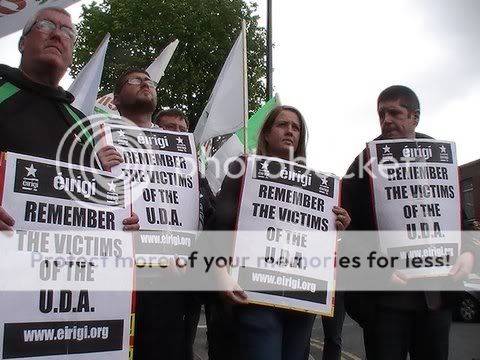
The second day of Elizabeth Windsor’s state visit to the Twenty-Six Counties saw éirígí activists and supporters staging protests at Islandbridge and Dublin Castle. The first protest was called after it was revealed that up to thirty leading members of the Ulster Defence Association had been invited to attend a wreath-laying ceremony in the Memorial Gardens in Islandbridge.
Before the protest even began, however, it was clear that the Gardaí were intent on provoking conflict. As éirígí Dublin City Councillor Louise Minihan arrived at the assembly point at Kilmainham Jail her car was pulled over and searched. During the course of the search a banner with the words ‘Fund Communities, Not Royal Visits!’ was seized on the spurious grounds of it being “offensive material”. A video of the search can be seen below.

 
By the time the Gardaí had completed their search of Minihan’s car a force of at least forty Gardaí had assembled outside of the building where the leaders of the 1916 rising were executed. There is little doubt that those brave men would have been disgusted at the prospect of the British Head of State and her UDA henchmen being afforded such an extravagant welcome by the Dublin government.

With Windsor now in the Memorial Gardens the thirty or so protesters made their way along Inchicore Road with the intention of demonstrating at the junction of Memorial Road and the N4. But this was not to be, as the Gardaí blocked access to Memorial Road with a line of rapidly deployed boys in yellow. When questioned on the legality of his impromptu roadblock, the commanding Garda replied that he was acting under the provisions contained within Section 21, a phrase that was becoming all too familiar to people across Dublin.


With their preferred route to the Memorial Gardens blocked the protesters returned to Kilmainham Jail to lay a wreath in memory of the victims of the UDA, before making a second attempt to access the Gardens. On this occasion upwards of 100 Gardaí were deployed to block the junction of South Circular Road and the N4. Although not as close to the Memorial Gardens as had been originally intended, the protesters’ voices, whistles and bodhráns loudly proclaimed their opposition to the mass murderers of the UDA.

While the protest may not have been particularly large that did not diminish from the hugely important principle upon which is was based; that it was morally bankrupt for the Twenty-Six County authorities to invite the leaders of one of the most vicious of unionist death squads to Dublin. As befitting an act of solidarity with the victims of the UDA, the protest was conducted with discipline and dignity throughout, despite the provocations of the state’s bully-boys.


éirígí Sligeach activist Gerry Casey, who was among those taking part in the demonstration at Islandbridge, slammed the actions of the Gardai in attempting to prevent legitimate peaceful protests as "beneath contempt".

Casey said:  "It is highly ironic that those of us protesting against the presence of the UDA at Islandbridge are intimidated and threatened while those unionist death squad leaders are received as special guests complete with Garda protection.  Even more so was the fact that Gardai siezed a 'fund communities not royal visits' banner from the car of Cllr Louise Minihan on the basis that it was somehow 'offensive'."


"What was really offensive was not a political banner but the presence of the UDA death squads and the role of the Gardai in attempting to prevent our protest.  Their intimidation of protesters by issuing threats to arrest  searching cars and individuals, seizing political material, manhandling people and trying to prevent photos and video footage being taken was beneath contempt."

Casey concluded:  "Once again the Gardai have shown themselves as a political police force who have no hesitation in breaking their own laws in order to protect the interests of the political and business elite in this state.  They also have put the interests of the British state and their proxies in the unionist death squads before  the interests of the citizens of this state, in particular the families of the victims of collusion who continue to seek justice for their loved ones."


Saturday, May 21, 2011

The Windsor Visit – A Bad Week for Irish Journalism

For months the political, business and media establishment have told us that the Windsor visit would result in all sorts of benefits and positive changes for this state.  So now as she has finally left our shores, what are all these benefits and what exactly has changed as a result of this visit?  Has there been any postive political developments?  Has there been any change in the relationship between the peoples of Britain and Ireland?


According to Kathy Sheridan writing in the Irish Times on Wednesday - 'All is changed, changed utterly'. The reality however is completely different. Look beyond the media hype and spin and it is clear that nothing has changed at all.

As the Windsors departed our shores yesterday (Friday) their government continue to deny the Irish people the right to self-determination. Just one hundred miles up the road from our capital city, 5000 British troops continue to occupy the six counties. The 9000 strong human rights abusing British paramilitary police – the RUC/PSNI – and the hundreds of MI5 operatives who enforce the occupation remain in place also.

The RUC/PSNI continue to engage in a systematic campaign of harassment and intimidation against those who dare challenge British rule in Ireland. They continue to carry out house-raids and terrorise nationalist estates as well as engaging in illegal stop and search operations which violate human rights legislation.


The internment of ex republican POW's has also been stepped up with Marian Price last week being the latest to be jailed at the behest of the British government without trial. The denial of political status for republican prisoners, their ill-treatment and torture and miscarriages of justice all continue unabated.

Have the families of the victims of the Dublin/Monaghan bombings, the anniversary of which was the very day Windsor arrived in Dublin, received a commitment that the British government will open their secret files on their role in the atrocities? Once more the answer is no as Britain rules out doing so, denying justice yet again to the families. Yet not a single whimper of protest from the sorry excuse for leaders of this so-called 'republic' who were too busy bowing and scraping before the 'British Royals' to stand up for the people they claim to govern on behalf of.


As for the relationship between the people of Ireland and Britain, nothing has changed there either.

Why not?  Put simply this visit was never about them. This was about a select wealthy political and business elite who care nothing for the working class people of either Ireland or Britain. It was about 'normalising', not relations between Irish and British people, but rather the continued military and political occupation of the six counties.

Over recent months the establishment went into overdrive promoting this visit and trying to downplay and silence opposition to it.  However, even more shameful was the unquestioning sycophantic role played by the corporate media over this visit. We have been treated to months and months of meaningless platitudes such as 'its time to move on', 'leave the past behind us', 'forgive and forget' and the extreme nonsense that somehow welcoming an undemocratic, sectarian, head of an occupying army is somehow us as a nation 'maturing'.

Gardai try to Intimidate éirígí activists legally erecting posters in Dublin on eve of Windsor visit
In a prime example of how overwhelmingly pro-establishment, compliant and gutless the corporate media in this state is, they ensured that there was absolutely no critical analysis of these platitudes and bogus assertions. There was virtually no questioning of the basis of any of those claims regardless of how ludricous they were. Instead they merely produced article after article, opinion piece after opinion piece, parroting the 'consensus' of how great the English Monarch is and how great this visit would be for all of us.  And as for anyone who had the cheek to question this consensus the corporate media spared no effort in their attempts to portray them as somehow being political dinosaurs filled with hate and bitterness.

So it would have been hard to imagine that Irish corporate media coverage of the actual visit itself could be any more cringeworthy. However, to be fair to them, they made a sterling effort and succeeded to produce four days of vomit inducing commentary that ignored the opposition to it and ignored the plight of Dublin residents suffering under the massive security operation and lock-down. They also deliberately ignored the co-ordinated and illegal actions of the Gardai in attempting to prevent legitimate peaceful protest.
Union Jack Flies above Government Buildings Dublin while Gardai throw Irish National Flag in Refuse truck
None dared break the consensus and report on Gardai stealing posters and banners or throwing the national flag in rubbish bins and refuse trucks as they effectively banned it from the capital city of this state. There was no questioning as to whether the tens of millions of euros spent on this visit would have been better spent elsewhere, such as in our hospitals and schools or for Special Needs Assistants and Carers or to assist the families of victims of British atrocities.

They did not dare direct their “move forward” comments towards Windsor and her government. Surely it would have been appropriate to ask that in order to 'move forward' and 'put the past behind us' that the British finally end their occupation of the six counties? Surely they could have asked them if they were genuine in wanting improved relations between Ireland and Britain that they open up their secret files on their involvement in the Dublin/Monaghan bombings and other atrocities they committed in collusion with the unionist death squads (whose leaders were her special guests at islandbridge on Wednesday)?


But no, silence on these issues was the consensus. No mention of the fact that these troops of hers continue to commit atrocities around the world.  Indeed within hours of Windsor departing from Ireland, hundreds of her notorious Royal Irish Regiment (RIR) soldiers marched through Ballymena after completing their latest stint in their brutal occupation of Afghanistan. 


No mention of the fact that she is a war crimes apologist. No mention of the fact that she continues to refuse to strip from the Paratroopers responsible for the Bloody Sunday massacre the honours that she awarded those murderers. 

Instead we heard a narrative of a little old lady and her husband over for a few quiet days in Ireland to promote peace and goodwill.  And no 'journalist' dared ask the obvious question – what exactly is it about this anti-democratic, sectarian, war crimes apologist who lives a life of privilege, that has the leaders of this so-called 'republic' here in the 26 counties almost wetting themselves with excitement at the prospect of being in her company and fawning over her? 

The one sure thing that could be said about the Irish corporate media's coverage was that it could not be described, no matter how broad a definition used, as 'journalism'. Those that produced such biased, unquestioning and sycophantic reports in this propaganda blitz should hang their heads in shame. It has exposed yet again a complete lack of any credible mainstream media outlet willing to critically examine or question the political establishment line.