Showing posts with label Republican. Show all posts

Sunday, July 3, 2011

From Socialism Alone Can the Salvation of Ireland Come

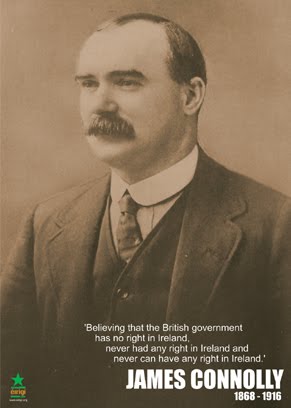
éirígíWhen éirígí was established as a campaigns group in April 2006 it did so as an avowedly socialist republican organisation, founded upon the principles of that champion of revolutionary socialism in Ireland, James Connolly.
The activists who ultimately founded éirígí had first asked themselves two questions: Was the objective of a socialist republic still relevant in today’s world? And if so, was there a need for a new political organisation to fight for the creation of that republic? With the answer to both these questions being a definitive yes, éirígí came into existence.
Back in December of last year, the party reached another significant milestone with the publication of a major ideological policy paper. From Socialism Alone Can the Salvation of Ireland Come is not only an important development for éirígí as a political party; it is also an important for the development of socialist republicanism in Ireland.
From Socialism Alone Can the Salvation of Ireland Come does not simply reject capitalism in all of its forms; it also sets out éirígí’s vision of an alternative society based upon the public ownership of the means of production, distribution and exchange.
Over the course of the last century many Irish republicans have come to the conclusion that an Ireland which remained capitalist post a British withdrawal would not really be free at all. And éirígí is proud to follow in that tradition, to follow in the footsteps of organisations such as the Irish Socialist Republican Party and the Republican Congress and of individuals like Peadar O’Donnell, Liam Mellows, Constance Markiewicz, Frank Ryan and Mairéad Farrell.
However, From Socialism Alone Can the Salvation of Ireland Come is not just about éirígí taking its place in Ireland’s revolutionary tradition. It is also about changing the parameters of debate in republican Ireland and beyond. It is about building the theoretical foundations for a powerful movement in Ireland that will be uncompromisingly republican and socialist. A revolutionary republican movement that has class politics at the core of its analysis, a movement that will never again commit the mistakes of militarism, constitutionalism or the pernicious notion that labour ‘must wait’.
The process by which éirígí developed and adopted From Socialism Alone Can the Salvation of Ireland Come was itself an example of the type of participative democracy that éirígí wishes to see at the heart of a new socialist Ireland. This process saw an initial draft debated by the entire membership within their respective local Ciorcail (branches). Each individual member was afforded the right to suggest deletions, additions and amendments to the document.
Once the first round of discussion had been completed a second draft of the paper, based upon the feedback received from the membership, was drafted. This second draft was then circulated to the entire membership and again debated within the local Ciorcail. The feedback from this second round of discussions informed the drafting of the third and final draft of From Socialism Alone Can the Salvation of Ireland Come.
For the first time a dispersed voting procedure was used which saw members voting at meeting of their local ciorcal on whether to adopt or reject the paper. As with all major strategic and policy issues each member of the party had an equal vote. The result of this vote saw the paper being unanimously adopted.
While the process of developing and adopting From Socialism Alone Can the Salvation of Ireland Come took a number of months to complete, it was time well spent. éirígí’s unique decisions-making process, as contained within Bunreacht éirígí, places consensus building at the heart of a process of decision making.
Many Irish republican and socialist organisations are based upon outdated and anti-democratic ‘top-down’ models of decision-making. Such models are inherently unstable, leading to leadership cliques and internal divisions. Organisations which use delegate based organisational models, pressure cooker conferences and artificial deadlines to make decisions are invariably corrupted by leaderships who think they know better than their memberships.
Announcing the public launch of From Socialism Alone Can the Salvation of Ireland Come, cathaoirleach éirígí Brian Leeson said: “Ireland today is at a crossroads. We can continue down the path of capitalism and imperialism that has partitioned our country, exploited our population and impoverished our communities or we can strike out for a better future based upon national independence and socialism.
“From Socialism Alone Can the Salvation of Ireland Come correctly asserts that the only option that will work for the vast majority of the Irish people is that of independence and socialism.
“There can be no compromise between the exploiter and the exploited. It is a matter of their prosperity or ours – the slave owner and the slave cannot be prosperous together.
“éirígí is under no illusions as to the mammoth scale of the task that has been set out in this document. It is the same task that confronted the men and women of 1916 and it is the same task that confronted the thousands of republicans who fought the struggle over the last 40 years – it is about nothing less than the re-conquest of Ireland by the working people of Ireland.
“We need to start small while thinking big. We need to organise in our communities, in our workplaces, in our places of education, in our homes and on our streets. We need to make the argument with every single person who has no vested interest in the current rotten system that there is a better way and a better destination. There is a system that the working people of Ireland can have a stake in – that system is socialism and the time to start fighting for that system is now.”
To read From Socialism Alone Can the Salvation of Ireland Come, click on the image below
 

Tuesday, February 1, 2011

éirígí Announces Names of Belfast City Council Candidates

Pádraic Mac Coitiréirígí has announced the names of two candidates who will be standing in May’s Six County local government elections.

John McCusker and Pádraic Mac Coitir will both be standing in Belfast; McCusker in the Lower Falls constituency and Mac Coitir in the Upper Falls area.

The socialist republican party took the decision to intervene in the council elections at its Belfast Ard-Fheis on January 23.

Republican ex-prisoner and former blanketman Pádraic Mac Coitir lives in the Lenadoon area of west Belfast and has been involved in socialist republican and community politics since 1970.

He said: “When I first became involved in the republican struggle, the goals of the civil rights movement were making the headlines, including the right to a job and the right to a home. Forty years later, these very basic and very limited demands have still not been achieved.

“This is why there is a need for a party like éirígí to stand in these elections: to reinvigorate the struggle for social and economic justice and the fight against partition and the British occupation.

“I am very proud to have been chosen by the éirígí membership to represent the party and its socialist republican politics and I am looking forward to engaging with as many working class people as possible in west Belfast over the next number of months.”

Thirty-three-year-old Falls Road man John McCusker holds a masters in international politics and has been involved in the republican struggle all his adult life.

John McCuskerHe said: “In light of the current economic crisis, it is clear that the old solutions and the old institutions have failed west Belfast miserably. What éirígí is bringing to this election is a platform that stands for active opposition to British government and Stormont cuts, a platform that offers an alternative to discrimination, poverty and partition and a platform that stands for rebuilding strong, vibrant communities.

“I am honoured to represent that platform and the politics of éirígí.”
Announcing their candidature, cathaoirleach éirígí Brian Leeson said: “In line with the decision taken by the party membership at our recent Ard-Fheis, éirígí will be standing candidates in both of the west Belfast local government constituencies.

“John McCusker and Pádraic Mac Coitir are two sterling activists who have devoted decades between them in fighting for the rights of working class people and in pursuance of socialist republican objectives.

“West Belfast has been discriminated against for decades and remains one of the most socially and economically deprived areas in western Europe. This was the case 20 years ago and it remains the case today. The vicious cuts which are being implemented by the British government and its Stormont administration are going to make an already bad situation an awful lot worse.

“éirígí is standing in this election to give the working class people of west Belfast an opportunity to say enough is enough. The fight back against poverty and partition, against inequality and exploitation starts now and there are no two better people to be at the forefront of that fight than John McCusker and Pádraic Mac Coitir.”

Leeson added: “Elections will constitute only part of that fight back. Ultimately, real change in this society will only come about when enough people get politically active in their communities, on the streets and in their workplaces.

“This will be the core message of éirígí’s electoral campaign: Together, working class people have the power to stop and rollback the cuts and, eventually, remove those responsible from power.”

Sunday, January 23, 2011

éirígí Ard Fheis takes Place in Belfast Today

éirígí's re-convened Ard Fheis takes place today in Belfast [Sunday January 23].

The annual national conference was set to take place in Belfast on December 4 last but had to be postponed due to the treacherous weather conditions then prevailing across the country.  The Ard Fheis will now go ahead at the same venue, the Cultúrlann McAdam Ó Fiaich cultural centre on Belfast’s Falls Road.


éirígí general secretary Breandán MacCionnaith said: “It was unfortunate but absolutely necessary that we had to postpone the Ard Fheis last month.  However, the format and matters to be discussed on Sunday today will be the same."

“It is significant that éirígí is holding its Ard Fheis in Belfast.  The birth of Irish republicanism was announced in June 1795 on Cave Hill above the city by Wolfe Tone, Henry Joy McCracken, Thomas Russell, Samuel Neilsen and a number of other United Irishmen."

“Today, the struggle against partition and for Irish independence and reunification continues to be a 32-county one.  Equally, the struggle against economic injustice and for socialism in Ireland must also be a 32-county one."

“Our objective is a sovereign, democratic, socialist republic for all of Ireland.  The current crisis within capitalism in the Twenty-Six Counties demonstrates yet again the inherently unjust and anti-working class nature of that failed system throughout Ireland and elsewhere.  Equally, the budget adopted at Stormont at the behest of Westminster demonstrates the subservient, colonial nature of that administration."

“At the Ard Fheis, éirígí will be putting forward our alternative vision for a new independent country with the formal launch of the party’s major policy paper on socialism in Ireland."


“When éirígí was established in 2006, it based its project on building a solid foundation for socialist republicanism in Ireland.  The task ahead of us is to bring others to the view that cosmetic tinkering with the two partitionist, economic, social and political systems in this country cannot bring about meaningful change to the lives of working people."

“We firmly believe that that, by launching this document, many others will see that the basis for equality lies in the establishment of a completely new social, economic and political order throughout Ireland.”

MacCionnaith continued: “éirígí will be also laying out its plans for the time ahead and encouraging all republicans and socialists to get actively involved in a rejuvenated struggle for national independence and socialism.”

Friday, August 13, 2010

An Appreciation of Jim Gralton - Leitrim's Unrepentant Communist

On August 13, 1933 Jim Gralton was forced to board a Trans-Atlantic Liner in Cork which was to set sail for the USA.  Jim had been arrested on August 10 at a friends house in Gorvagh, County Leitrim and brought to Ballinamore Barracks where he was detained before been brought to Cork for his deportation.  He had been living on the run since February of that year following the issuing of a deportation order by the courts who ruled that he had to leave Ireland by March 5.  His deportation 77 years ago today makes him the only  native Irishman to be deported from this state.


He was born in Effernagh close to Carrick on Shannon in County Leitrim on April 17 1886.  His education, such as it was, was received in nearby Kiltoghert school.  Like most young people at the time, he left school early, aged just 14.  After working for a number of employers in the local area, fed up with the harsh treatment he and others suffered at their hands, Jim headed for Dublin where he enlisted in the British army.


His rebellious behaviour was not long coming through and he endured punishment of 84 days on "bread and water" for his refusal to shine the leggings and buttons of one of his officers.  He was then posted to India, but refused to go in protest at British policies in Ireland.  For his defiance and protest, Jim was jailed for a year and subsequently deserted the army, going to work for a time in the coal mines of Wales and in Liverpool docks. 


He then got employment as a Ship's stoker and eventually settled in New York where he became a US citizen in 1909.  In the midst of the great wealth in the USA, Jim was appalled at the harsh, slave-like conditions that workers endured, which led him to become a firm believer in supporting the rights of workers and in Socialism.


From the time he arrived in the US, Jim was active in supporting and raising much needed funds for both the Irish Republican struggle and for fellow workers in New York.  He became a member of the US Communist party and became heavily involved in Trade Union activity.  In the wake of the 1916 Rising, and after studying of the writings of James Connolly, Jim became a founding member of the James Connolly Club in New York.


Almost a decade and a half after arriving in the US, Jim decided to return home to Ireland in June 1921, just a month before the truce in the Tan war commenced on the 11th of July.  During the war, the notorious Black and Tans had burnt the local Temperance Hall beside Gowel Church to the ground.  On his return, Jim promised local people he would replace it and set about with his own money and with local support, building a new hall on his fathers land near Effernagh crossroads.

The new hall, which to be called the Pearse-Connolly Hall, was eventually opened on December 31 1921 and became an integral part of the everyday lives of the local community.  Amongst its many uses was the holding in classes of a wide range of subjects including Irish, English, music, dancing, civics and Agricultural science.  This was also a time of many land disputes and the Hall was also used to hold Land courts to settle many of these disputes.  Despite the good work Jim was doing for his community and despite the valuable educational service that was been provided, not everyone was happy.


The Catholic church in particular were extremely unhappy.  They denounced him at every opportunity, at the pulpit during mass and in letters, going as far as to describe him as an extremely dangerous socialist and even an "Anti-Christ".  They accused him of "leading a campaign of Land agitation", of trying to take the youth of the area away from the Catholic Church and of teaching communism to them in his classes.


The Free State forces also were unhappy with his activities, and on May 24 1922, they raided the Hall in a failed attempt to arrest Jim.  The following month, as Civil War loomed, he got out and returned to the US.  He did not return to Ireland until 1932 following the death of his brother Charlie who looked after and ran the family farm and following the securing of power in the 26-counties by Fianna Fáil.   Like many other people at that time, Jim was of the mistaken belief that a Fianna Fáil government would allow for the development of progressive politics in his homeland.

Following his return to Ireland. Jim re-opened the Connolly-Pearse Hall which had been closed for many years while he was in the US.  He also involved himself once again in left-wing agitation, joining the Revolutionary Workers Group (a forerunner of the Communist Party of Ireland CPI).  As well as the hall being used for dances and other social activities, meetings were also held there highlighting issues such as unemployment and the rights of workers and tenants.


Vincent McGrath of the Rossport 5 Addresses Jim Gralton commemoration at site of Connolly - Pearse Hall


He spoke at many anti-eviction meetings and following the eviction of a worker from his home in Keadue, also in County Leitrim, Jim joined with a local IRA group in re-instating the worker and his family back into their family home.  This radicalism and persistent campaigning on such issues was of major concern once again to conservatives in general and to the Catholic Church and Fianna Fáil in particular.


Once again, Jim was denounced as a massive campaign was launched by the clergy against him and the views he represented.  Shamefully, many of his former comrades turned their backs on him, as the church demanded that the hall, which they described as a "den of iniquity" be shut down.


The hall came under physical attack on many occasions.  Shots were fired into it during a dance and  an attempt to blow it up with a bomb failed.  Finally, on Christmas Eve 1932, the Hall was eventually destroyed when it was burned to the ground.

In February of 1933, at the behest of the Catholic Church, the Fianna Fáil government ordered the deportation of Jim from his homeland by March 5 on the spurious grounds of him being an "undesirable alien".  Instead of complying with the order, Jim went on the run, staying with friends and neighbours in the area.  During his time on the run, the Revolutionary Workers Group organised a campaign in support of Jim.  Public meetings were organised and addressed by Jim himself, and by other prominent Republican Socialists  of the time such as George Gilmore and Peadar O'Donnell.  Many of these meetings were attacked and broken up by reactionaries.

Finally on August 10 1933, the Free State caught up with Jim, capturing him at a friends house in Gorvagh.  He was taken to Ballinamore Barracks where he was detained before being transported to Cork where he was put on board a Trans-Atlantic Liner and deported to the US against his will. He was never again allowed to return to Ireland.

Undeterred, upon his arrival back in the US, Jim once again got involved in Trade Unionism and left wing politics.  Along with Gerald O'Reilly, a close colleague of George Gilmore, Jim set up the Irish Workers Group in New York.  He became a Trade Union organiser, encouraging the involvement of women within the Unions, and set about  promoting, republishing and distributing the works of James Connolly.  During the Spanish Civil War, he raised funds for the International Brigades who were going to Spain to fight against Fascism and in defence of the Republic.  


A committed and unrepentant Communist up to his last breath, Jim Gralton died in exile in New York on December 29 1945 and is buried in Woodlawn cemetery in the Bronx area of the City.


Woodlawn Cemetery, The Bronx, New York where Jim Gralton is buried


To conclude fittingly, the final words go to a comrade of Jim's, Charlie Byrne.  Speaking at Jim's Graveside in the Bronx in 2005 to commemorate the 60th anniversary of his death, Charlie said:


"Let all of us who believe in the principles for which Gralton stood, pledge ourselves anew to the continuation of the fight for the complete political, cultural and economic rights of the working classes in all lands, no crying, no weeping over his grave at Woodlawn. There is work to be done, so let us carry on; Gralton would have it that way."